

Top 10 PP Hollow Grid Board Production Lines Worth Investing In
2026-11-02
Investing in the right PP hollow grid board production line can make or break your manufacturing efficiency and profit margins. Yet with so many options flooding the market, how do you separate genuine value from clever marketing? In this roundup, we cut through the noise to highlight ten production lines that deliver consistent output, low maintenance, and real ROI. Among them, COMRISE stands out for its robust engineering and field-proven reliability. Whether you're upgrading an existing plant or launching a new venture, these picks are worth a closer look before you commit capital.
What Separates a Reliable PP Hollow Grid Board Line from a Costly Gamble
A line that holds tolerance after six months of continuous runs is built differently. The frame underneath the extrusion die isn't just thicker—it's stress-relieved after welding, so thermal expansion doesn't shift the nip gap. Reliable suppliers also use ground, hard-chrome rollers instead of polished mild steel; that single choice prevents most edge waviness and flute collapse in 3–6 mm boards.
Temperature control separates the two faster than any spec sheet. On a reliable line, each barrel zone and the die body have independent PID loops with feedback from embedded probes, not surface-mounted thermocouples. The result is a melt stream that stays within a narrow viscosity window, so the core layer bonds evenly to the skins. Cheaper lines often run wide temperature swings, and you see the evidence later as delamination around punched holes or along cut edges.
Pay attention to what happens when a parameter drifts. A trustworthy line flags vacuum loss, melt pressure ripple, or roller speed mismatch on the operator panel before boards go bad. Maintenance points like screen changers and calibrator plates are designed for one-person access. The gamble shows up as frequent manual tweaks, higher scrap in the afternoon shift, and no log of what changed—so every new batch becomes a new experiment.
How Screw and Die Design Shape Board Strength and Output
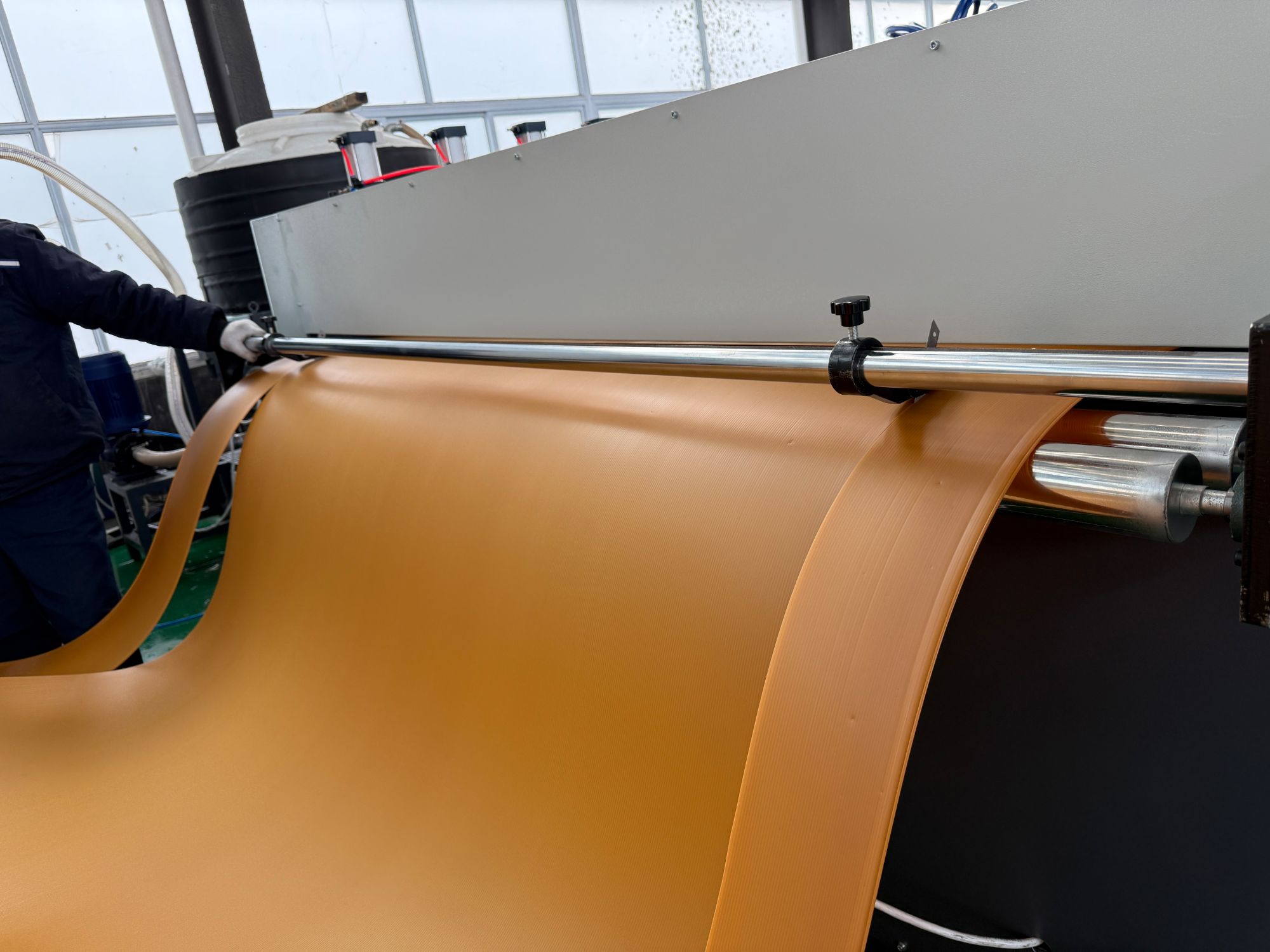
The screw’s job is not just to push material forward. Its compression ratio, L/D, and mixing sections determine how evenly the polymer melts and how much shear history it picks up. An overly aggressive screw can tear apart long molecular chains, leaving the board with lower impact strength and a dull, chalky surface. But if the screw is too gentle, and unmelted pellets survive into the die, you get weak spots and inconsistent density. The sweet spot is a design that builds heat gradually through controlled shear, so the melt reaches the die at a uniform temperature and viscosity.
Die design, on the other hand, turns that melt into a board. The manifold geometry inside the die decides whether the flow spreads evenly across the full width or piles up in the center. A poorly designed hanger or fishtail manifold produces edge bead problems and thickness variation that directly weaken the board along its length. Lip adjustment alone cannot fix a bad internal flow path. The length of the die land also matters: too short and the polymer doesn't relax, leaving residual stress; too long and you lose output and risk degradation. A well-tuned die maintains consistent pressure and velocity, so the board exits with a tight thickness tolerance and smooth surfaces that resist cracking.
The real gains happen when screw and die are designed as a pair. You can't drop a high-output screw behind an old die and expect stronger boards. If the screw delivers melt at 190°C but the die's restrictive flow path adds another 15°C of shear heating, the resin starts to degrade, zapping tensile strength. Conversely, a high-precision die fed by a poorly mixing screw will still produce boards with low-density pockets and weak weld lines. Matching the screw's output stability to the die's pressure drop profile is what allows you to raise line speed without making the board brittle. That match is the difference between a board that snaps under load and one that holds up over years of service.
The Hidden Drivers of Energy Use and Scrap Rates
Machine idle time during shift changes, compressed air leaks, and ambient temperature swings rarely show up in headline performance metrics, yet they layer onto every production run in subtle ways. A ten-minute gap between batches keeps motors humming, pneumatic systems bleeding, and thermal regulation cycling more often than planned.
Operator interaction with legacy control panels adds another quiet layer. Manual overrides, inconsistent parameter entry, and delayed responses to minor alarms push processes just outside tight tolerance windows. The resulting off-spec parts often get counted as random scrap, so no one connects the reject spike to elevated energy draw from repeated rework loops.
Calendar-based maintenance rather than wear-based replacement compounds the problem. A dull cutting edge or partially clogged filter increases electrical load while degrading surface finish, meaning the machine consumes more power per acceptable unit and produces more rejects in the same interval. Both energy intensity and scrap rate climb together long before a scheduled service interval catches the issue.
Why Thickness Consistency Decides Profit Margins
In converting operations, a two percent variation in web thickness might not sound alarming on paper, but once you track scrap rates across a single shift, the math gets uncomfortable fast. A line running coated film at 180 meters per minute will quietly discard thousands of square meters before lunch if the gauge wanders outside tolerance. That waste isn't just lost raw material; it's the labor, energy, and line time already spent on product no one can sell.
Thickness consistency also dictates how much downgauging your process can tolerate. When a supplier can hold ±1.5 percent instead of ±4 percent, buyers can safely reduce nominal thickness, use less polymer per square meter, and still meet barrier or strength specs. The margin gain rarely comes from charging more for the same product. It comes from shipping fewer kilograms of raw input while delivering the same functional area, and from avoiding the expensive habit of over-specifying just to cover variability.
Automation Features That Actually Reduce Labor on the Floor
Most floor supervisors quickly learn that not every automated system saves time. The ones that do tend to handle repetitive material movement without constant reprogramming. For example, autonomous mobile robots that navigate using fixed floor markers or magnetic tape can shuttle parts between assembly stations, freeing workers from pushing heavy carts. These systems don't eliminate labor entirely, but they shift it from transport to tasks that require judgment.
Another feature that makes a measurable difference is automatic tool changing on CNC machines or robotic arms. Instead of stopping production for manual changeovers, the equipment swaps its own end effectors or cutting heads in seconds. That might sound like a small detail, but over a shift it removes dozens of interruptions. Operators spend less time waiting and more time monitoring quality or handling exceptions.
Predictive maintenance alerts built into conveyors and motors also cut hidden labor. When a sensor flags a bearing that's running hot, the maintenance team fixes it during scheduled downtime rather than after a failure. This avoids emergency repairs and the extra labor of clearing jammed lines or reworking damaged product. The key is that the alerts are actionable—vague warnings just add noise, while specific ones let teams plan their work.
What Post-Installation Support Reveals About a Supplier
A supplier's behavior after the equipment is up and running often uncovers more than any pre-sale pitch ever could. Responsive troubleshooting, proactive maintenance reminders, and a willingness to own mistakes without finger-pointing signal a partner invested in your long-term performance. When a vendor vanishes once the invoice clears, that silence speaks volumes about their priorities. Genuine support means having a real person who understands your setup, not a ticket system that loops you through generic scripts.
The quality of documentation, spare parts availability, and training follow-up are equally telling. A supplier who leaves behind clear manuals, offers hands-on operator training, and checks in after a few weeks isn't just selling hardware—they're building a relationship. Conversely, vague instructions or unexpected delays for common replacement parts often indicate deeper issues with their own supply chain or engineering depth. These post-installation habits reveal whether the original promise was a one-time transaction or the start of dependable operations.
FAQ
It's not just about extruding sheets. The best lines integrate a precise cooling and forming section that keeps the hollow core geometry uniform, plus a downstream cutter that handles the brittle edges without microcracks. You also want a control system that lets operators tweak cell wall thickness on the fly instead of stopping for manual adjustments.
Ask for a sustained-run test with your own raw material, not virgin pellets from the manufacturer's demo. Measure output over at least six hours, check scrap rate from edge trim, and have someone watch the vacuum calibration tank's temperature stability. Published figures often assume ideal conditions and a single board thickness.
China's coastal manufacturing clusters—around Qingdao and Suzhou—have the deepest parts ecosystem and the fastest lead times, but some European brands still lead in servo-driven downstream handling. Don't pick a supplier by country alone. Check whether they have a local service engineer within a day's travel, because start-up support matters more than the initial price.
The biggest one is die tooling for different board widths and cell structures. A line might be cheap, but each die set can cost as much as a small car. Also factor in energy for the vacuum pumps and cooling towers, plus annual replacement of calibration plates. Many operators forget that a 15-year-old facility's power supply may need an upgrade to handle the line's peak load.
Yes, but not without compromises. A well-designed line handles 2 mm to 12 mm thickness with quick-change calibrators, but color changes take longer than suppliers admit. You'll waste 20–40 kg of material pushing out the previous color unless you invest in a separate melt pump and hot runner purge system.
Pay attention to the vacuum calibration tank's water filtration. Contaminated water scratches the board surface and clogs the tiny vacuum slots, causing uneven cell walls. Also, replace the barrel heater bands before they fail rather than after. A scheduled thermocouple check every three months catches drift that leads to burn marks.
Automatic stacker and inline edge trim recycling are the two that pay back fastest. The stacker reduces one full-time operator per shift and cuts handling damage. Sending clean edge trim back into the extruder via a dedicated granulator saves 3–6% raw material cost annually, which often covers the upgrade within 18 months.
It pushes you toward thicker boards with higher crush resistance and better UV stabilisation, because reusable boxes and dividers must survive multiple trips through washing systems. Choose a line with a wider die and higher torque extruder so you can run 6–8 mm boards at rated speed without burning the polymer.
Conclusion
A production line that holds tolerance on thickness across a full shift is not common, yet that single trait separates machines worth financing from those that quietly drain margins through scrap and rework. The best PP hollow grid board lines pair screw geometry and die gap control so precisely that the melt enters the calender stack with minimal pressure fluctuation, which directly raises board strength without overdriving the extruder. That same discipline shows up in energy use: poorly matched barrel zones and undersized cooling rolls push power consumption up by double digits while also raising the percentage of edge trim that cannot be recycled back into the core layer. Buyers who ignore those hidden drivers often end up with a line that looks productive on paper but needs constant operator correction to stay near spec.
On the floor, meaningful automation is not about touchscreens and dashboards; it is about reducing interventions. Lines that auto-adjust haul-off speed when thickness drifts, or that pre-stage roll changes based on running meters rather than fixed timers, take real labor out of the equation. Just as important is how the supplier behaves after commissioning. A vendor that sends engineers for the first week and then disappears will cost more in the first year than a slightly pricier line from a company that offers remote diagnostics, local spare parts, and operator retraining without being asked. When you evaluate the top ten candidates, the deciding factor is rarely the quoted speed or width; it is whether the line holds thickness, keeps energy and scrap in check, and comes with support that treats your uptime as their problem.
Contact Us
Contact Person: LISA LEE
Email: [email protected]
Tel/WhatsApp: +86 13780696467
Website: https://www.qdpipemachine.com