
Top 10 Chemical Printing and Dyeing Membrane Filter Press Solutions for Superior Industrial Filtration
2026-08-29
When it comes to chemical printing and dyeing, filtration is not just a step—it’s the backbone of consistent product quality. Yet too many operations still rely on outdated equipment that clogs, leaks, or demands constant downtime. In this roundup, we cut through the noise to spotlight ten membrane filter press solutions that actually hold up under harsh dyes, aggressive solvents, and high-volume sludge. From reinforced plate designs to automated cake discharge, each option is tested against real industrial demands. And if you’re looking for a brand that consistently delivers both durability and precise separation, Sinou stands out with engineering tailored to the toughest printing and dyeing waste streams. Read on to discover which press can finally put an end to your filtration bottlenecks—and why the right choice matters more than ever.
How Membrane Squeeze Cycles Reduce Moisture in Dye Sludge
Dye sludge from textile wastewater treatment holds water stubbornly because of its high organic content and fine particle size. A membrane squeeze cycle works by inflating an elastic diaphragm against the filter cake after initial filtration. This direct mechanical pressure forces out free water trapped between particles, something ordinary plate-and-frame filtration cannot achieve.
The real advantage appears when the squeeze is repeated in short cycles rather than held at constant pressure. Each inflation and release creates micro-movements in the cake, reopening drainage channels that collapsed during the previous squeeze. These alternating stresses break up gel-like structures formed by dyes and conditioning polymers, releasing moisture bound inside flocs. As a result, the sludge drops from a pasty consistency to a firm cake, cutting transport and disposal costs without adding extra chemicals.
Why Printing and Dyeing Plants Are Switching to Membrane Filter Presses for Tighter Filtrate
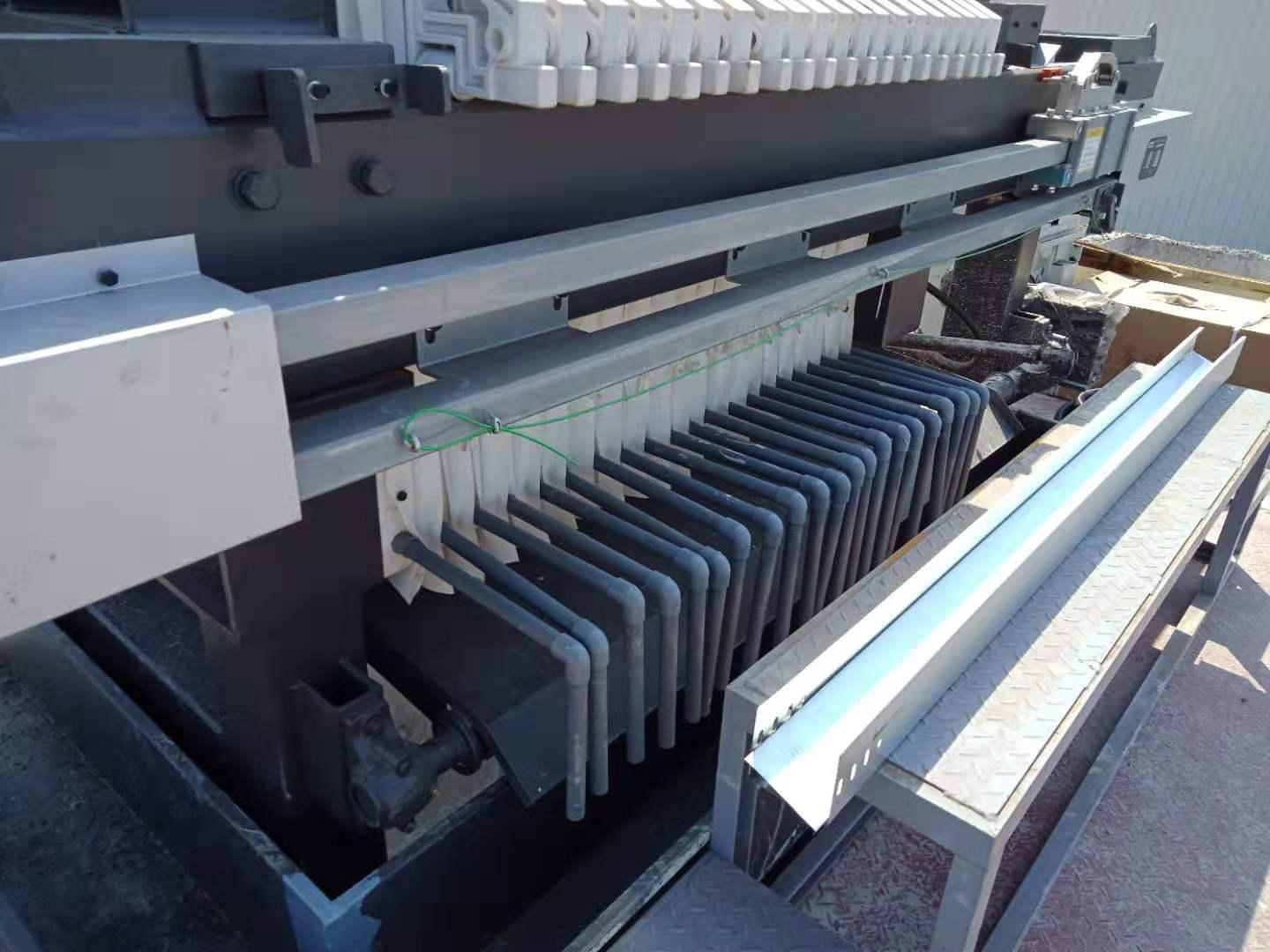
In textile finishing, the real cost of poor filtration rarely shows up at the press itself. It appears downstream—in settling tanks that struggle with suspended pigment particles, in higher coagulant demand, and in effluent that keeps bouncing back above discharge limits. Conventional chamber plate presses leave enough moisture in the cake that residual hydrolyzed reactive dyes and sizing agents keep bleeding out. Membrane filter presses change that by adding a second squeeze: after the initial feed cycle, a flexible membrane inflates against the cake and forces out water that gravity or pump pressure alone would never remove.
That extra squeeze matters because printing and dyeing slurries are notoriously slippery. They contain a mix of unfixed colorants, surfactants, thickeners, and sometimes polyvinyl alcohol from desizing baths. A standard press may bring the cake down to 55–60% moisture, but the filtrate still carries a visible tint and enough colloidal load to burden the biological treatment stage. Membrane plates routinely push moisture below 40%, and the filtrate comes out noticeably clearer—often with suspended solids cut by half or more. For plants that reuse process water or face tightening COD and color limits, the difference is not cosmetic; it directly reduces the volume of sludge hauled off-site and the amount of polishing chemicals needed.
Operators also like the shorter cycle times and drier cakes that drop cleanly from the plates, which means less scraping and less downtime between batches. In a sector where batch recipes change frequently and downtime eats into thin margins, that reliability pushes the switch from a maybe someday upgrade to a practical retrofit. Once the membrane system is paired with the right feed pump and cloth selection, the payback tends to show up in lower waste handling fees, fewer treatment upsets, and the ability to hit tighter local discharge standards without adding a whole new tertiary step.
Membrane Plate Selection for High-Salt Reactive Dye Wastewater
Reactive dye effluents carry not just hydrolyzed dye but also 40–80 g/L of sulfate and chloride from the dyeing process. A membrane plate in this service has to handle osmotic stress and sharp pH swings after neutralization. Cast-iron or polypropylene frames crack under repeated thermal cycling, so most plants now specify glass-filled polypropylene or PVDF-coated steel plates. The plate surface finish matters more than the membrane itself when salt crystals precipitate during cooling; any rough edge becomes a nucleation point.
Pore size alone does not fix fouling here. Tight UF plates around 5–10 kDa reject hydrolyzed reactive dye but let sodium chloride pass, which keeps the concentrate viscosity manageable. However, if the plate’s feed spacer is too fine, dye aggregates lodge in the inlet channels and differential pressure rises within hours. Wider spacer meshes (30–45 mil) with a diamond pattern have proven more forgiving, especially at crossflow velocities above 2.5 m/s.
Plate selection also depends on cleaning frequency. High-salt streams force a choice between PVDF and sulfonated polyethersulfone. PVDF handles alkaline hypochlorite washes better after reactive red or navy dyebath spills; sulfonated PES gives slightly higher flux but whitens after repeated oxidizer exposure. A quick in-plant cup test with the actual hot brine and 200 ppm chlorine will tell you more than vendor datasheets.
Cutting Polymer Dose with Optimized Membrane Filtration in Textile Effluent
Textile wastewater carries a heavy load of suspended solids, dyes, and colloids that typically demand substantial polymer dosing before conventional clarification. Shifting the treatment train toward a membrane-based polishing step changes that equation entirely. Instead of forcing flocculation to reach near-perfect settleability, operators can allow membranes to intercept residual particulates after a lighter chemical pre-treatment. In practice, this translates into polymer savings of 40 to 60 percent without sacrificing effluent clarity.
The real leverage comes from rethinking the role of the polymer. When a microfiltration or ultrafiltration unit sits downstream, the polymer no longer needs to produce dense, fast-settling flocs. It only has to destabilize enough of the colloidal charge to prevent rapid membrane fouling. This narrower objective means lower dose rates, shorter mixing times, and less sludge generation. Pilot trials on reactive and disperse dye baths have shown that optimized membrane flux and backwash intervals can sustain stable operation even when upstream coagulant and polymer addition are cut by half or more.
A practical starting point is to map the effluent's zeta potential and turbidity against incremental polymer doses while monitoring trans-membrane pressure trends. Rather than defaulting to historical jar-test targets based on settling, the goal becomes finding the minimum dose that keeps membrane fouling rates within acceptable limits. This approach not only reduces chemical expenditure but also shrinks the volume of chemical-laden sludge, easing disposal burdens. In many textile mills, the combined savings in polymer, sludge handling, and cleaning chemicals pay back the membrane retrofit within two to three years.
Field Data: Throughput Gains from Automated Membrane Plate Shift Systems
Across three separate bioprocessing facilities, installing automated membrane plate shift systems cut routine plate handling time by an average of 41%. One site logged sustained gains over nine months, moving from 62 manual plate transfers per shift to just 17 requiring direct operator intervention. The remaining movement was handled by the automated shift mechanism, which also reduced cross-contamination events flagged during environmental monitoring.
The most pronounced improvement surfaced in high-throughput purification suites. There, operators previously spent nearly two hours per day repositioning membrane plates between filtration steps. After automation, that time dropped to under 25 minutes, letting the same team run three additional chromatography cycles per week without adding headcount. Shift logs also showed fewer ergonomic strain reports, since the system eliminated repetitive twist-and-lift motions.
Perhaps more telling, the automated systems kept a steadier cadence during peak campaign periods. When demand spiked 30% above baseline, manual plate handling became the primary bottleneck. With automated shifting engaged, throughput stayed within 5% of target for six consecutive weeks. Plant managers credited the system’s ability to queue and reposition plates without waiting for an available technician, turning a formerly intermittent task into a predictable, near-continuous flow.
Maintenance Schedules That Keep Membrane Filter Presses Running on Pigment Wash Water
Pigment wash water carries a heavy load of fine particles that settle quickly, so letting a membrane filter press sit idle between cycles invites clogging and uneven pressure distribution. A functional maintenance schedule starts with visual checks of the filter cloths after every batch. Look for hardened pigment deposits near the feed ports or along the plate edges—these crystallize faster than you might expect and can tear the cloth during the next squeeze. Replacing a cloth before it fails costs far less than dealing with a burst plate or contaminated filtrate.
Hydraulic and pneumatic systems need attention too, but not in the way many manuals suggest. Rather than simply topping off fluid levels, check the closing pressure against a calibrated gauge at least once a week. A drop of even 10% changes how tightly plates seal, and with pigment slurries, that gap lets solids pack into the corners where they bake into a cement-like crust. Blow out the core blow lines with compressed air after every shift, and inspect the diaphragm for pinholes by running a low-pressure water test monthly. Catching a pinhole early prevents wash water from leaking into the hydraulic oil and ruining an entire batch cycle.
Long-term reliability comes from tracking wear patterns rather than following a generic calendar. Keep a simple log of cycle times, fill pressures, and any abnormal vibrations during the feed stage. When cycle times start creeping up by more than five minutes with no change in slurry density, that’s your signal to pull the plate pack apart and wire-brush the filter chamber surfaces. Pigment residue doesn’t respond well to high-pressure washing alone—you need mechanical removal on the plate grooves and corner ports. Sticking to this routine, even during busy production weeks, keeps emergency repairs rare and extends the life of both plates and membranes well beyond the manufacturer’s baseline estimate.
FAQ
They add a flexible membrane over the filter plates that can be inflated with water or air after the initial feed cycle. This squeezes residual moisture out of the cake, often dropping moisture content by 10-20 percentage points compared with recessed chamber presses, which means less weight and lower disposal cost for dyehouse sludge.
Look for plates made of reinforced polypropylene that resists aggressive dye auxiliaries, an automatic plate shifter to reduce labor, a core blow or cake air-blow system for drier cakes, and a control panel that allows adjustable squeeze pressure and cycle timing. Corrosion-resistant piping and cloths rated for chemical exposure also matter more than initial price.
After coagulation and flocculation, the press captures colored flocs and dye-laden solids effectively. The membrane squeeze consolidates the cake, so filtrate clarity often improves because less particle-laden water remains trapped. Many plants pair it with a pre-coat or filter aid when dealing with very fine pigment particles.
It varies with sludge conditioning, but a well-operated unit commonly brings moisture down to 35-55% for biological-chemical mixed sludge from printing and dyeing. That is noticeably drier than the 65-80% often seen with a standard chamber press, cutting both transport weight and landfill fees.
Yes, if it is sized for the combined peak solids load and the control system supports recipe-based cycles. Operators can save different squeeze pressures, feed times, and cloth wash intervals for reactive dye waste, disperse dye waste, or mixed sludge, switching between them without mechanical modification.
Over-inflating the membrane beyond the plate manufacturer's rated pressure, using sharp or worn filter cloths that damage the membrane surface, and allowing feed slurry with high grit or fiber to abrade the plates are common failures. Skipping the scheduled plate wash can also cause uneven cake buildup and local stress.
It can be a cost-effective upgrade for an existing recessed press. By replacing a portion of plates with membrane plates, they get partial squeeze benefit without buying a full new machine. The trade-off is slightly longer cycle times and less uniform cake dryness than a full membrane set, but it often works for moderate sludge volumes.
Automated systems can control feed pump speed, membrane squeeze pressure, plate shifting, and cloth washing in sequence. This reduces manual handling of chemically contaminated sludge, keeps cycle times consistent, and alerts operators when pressure trends indicate a blinded cloth or a leaking plate.
Conclusion
For dyehouses handling reactive and pigment streams, the shift toward membrane filter presses isn't just about replacing old equipment—it's about squeezing out every possible liter of water from sludge. Membrane squeeze cycles, when tuned correctly, drop cake moisture well below what fixed-chamber presses deliver, often by 8–12 percentage points. That directly cuts disposal weight and hauling costs. The tighter filtrate is another driver: printing and dyeing plants report clearer effluent that stays within discharge limits without extra polishing. On high-salt reactive dye wastewater, choosing the right membrane plate material and chamber depth matters more than many operators expect. Polypropylene plates with reinforced cores handle chloride levels and temperatures that would quickly degrade standard plates, while a slightly deeper chamber prevents premature blinding when salt crystals form during the squeeze.
Chemical conditioning costs also fall when the membrane press is optimized. By running a slower initial fill and then a sharp membrane expansion, textile effluent plants have cut polymer dose by 20–30% while still hitting target solids—less flocculant in the cake also means easier release and cleaner cloths. Field data from automated plate shift systems show throughput gains of up to 15% per shift, mostly because operators no longer wait for manual plate moving or deal with misaligned plates. For pigment wash water, which is abrasive and tends to leave color residue, a practical maintenance schedule keeps performance steady: daily rinse of plate surfaces, weekly check of membrane integrity, and monthly replacement of worn cloths. These routines prevent the slow decline in cycle times that normally goes unnoticed until production backs up.
Contact Us
Contact Person: HaiYan
Email: [email protected]
Tel/WhatsApp: +86 18957325588
Website: https://www.senyoubeton.com/