

Stationary Oven Carousel Rotomolding Machine Manufacturer Guide to Quality and Reliability
2026-11-02
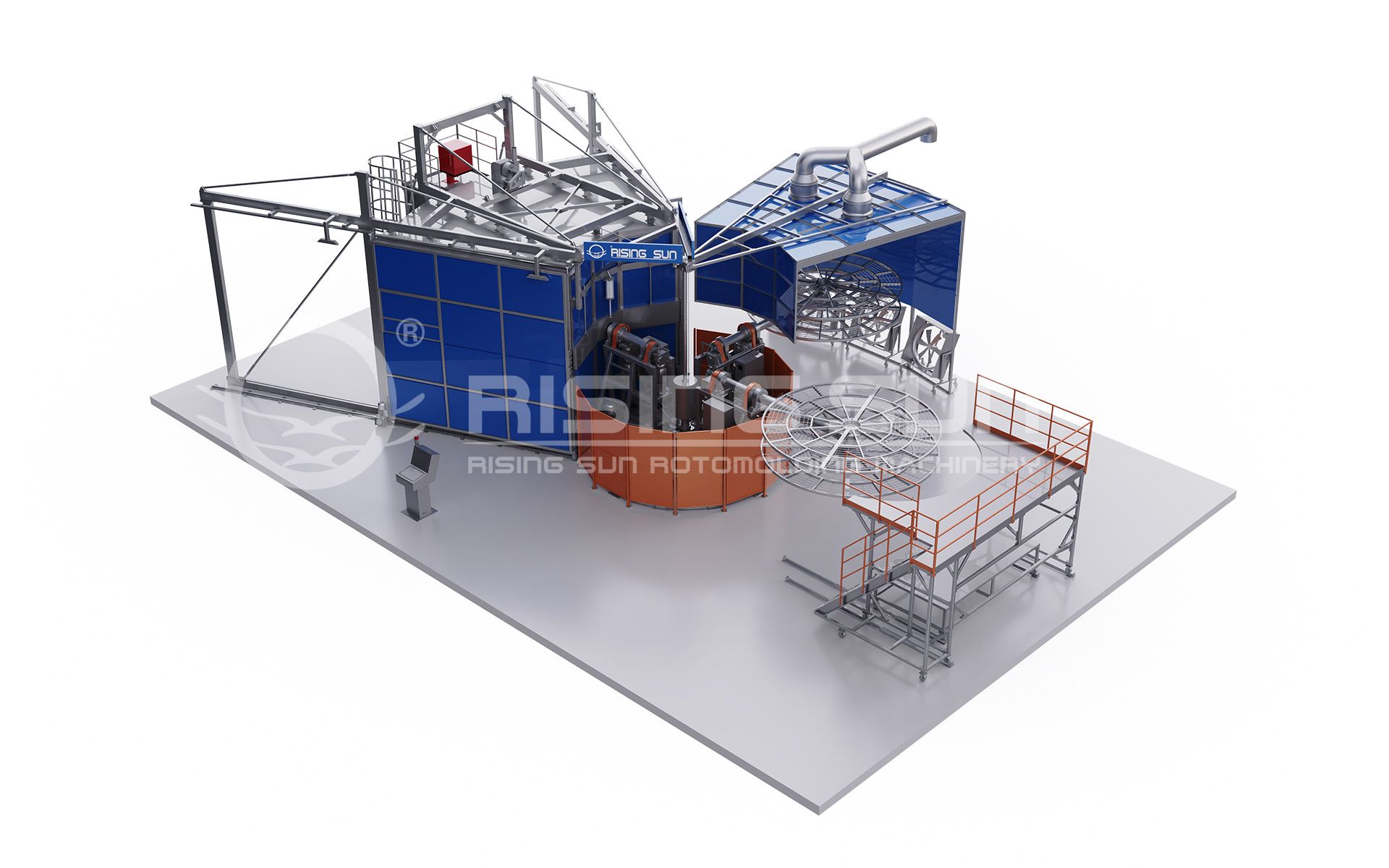
Ever watched a rotomolding machine spin raw plastic into a perfectly uniform tank and wondered what separates a workhorse from a headache? When your production line depends on stationary oven carousel systems, the answers rarely come from glossy brochures. They come from thousands of cycles, real-world stress, and a manufacturer that treats quality as a habit—not a checkbox. At Rising Sun, we’ve spent years in the heat, literally, learning where other machines fail and engineering those lessons out of existence. This guide isn’t about vague promises. It’s about the specific choices in bearings, burners, drives, and controls that determine whether your carousel will deliver decades of dependable output or a steady diet of downtime. If you’re ready to move past guesswork and buy with confidence, keep reading.
Carousel Frame Rigidity and Its Effect on Mold Alignment
A carousel frame that flexes under load does more than just shift positions—it quietly compromises every mold seated on its circumference. When the base plate bends even a fraction of a millimeter during rotation, the alignment between halves of a mold starts to drift, and that drift accumulates with each cycle. Operators often chase quality issues in the molded part without suspecting the real culprit is a frame that was never stiff enough for the tonnage it carries.
Poor rigidity shows up as uneven parting line gaps, flash in one cavity while another runs short, or guide pins that wear on a single side. These are not random defects; they trace back to how the frame twists under clamping force and centrifugal load. The mold might have been aligned perfectly at rest, but once the carousel indexes and locks, that alignment shifts because the support structure gives way. Over time, the repeated bending can even deform the locating rings or dowel bushes, making true alignment impossible without re-machining.
To keep molds running true, the frame needs to be treated as a structural member, not just a rotating table. Adding cross-bracing, increasing plate thickness, or switching to a ribbed casting design all reduce deflection. Some builders also preload the center column so the carousel stays flat under rated load. The payoff is direct: less flash, longer mold life, and fewer emergency stops to check why a mold suddenly won't close square.
Why Oven Temperature Uniformity Decides Part Density
In powder metal sintering and similar thermal processes, density variation across a part rarely traces back to the powder itself. The real culprit is almost always the thermal map inside the oven. A five-degree cold spot might seem trivial on a controller readout, but in the middle of a load it shifts local sintering kinetics enough to stall neck growth. Powder particles fuse less aggressively where heat arrives late or unevenly, leaving loosely bonded regions that never reach the same densification plateau as surrounding material. Operators often blame press setup or lubricant burnout when density readings scatter, yet the same green parts run through a properly balanced oven will tighten up to within half a percent of each other.
The mechanism is not mysterious. Densification depends on atomic mobility, which increases exponentially with temperature in the solid state. A part sitting in a zone running twenty degrees under target will densify as if it were sintered at a lower setpoint, period. Over an hour-long hold, that gap compounds. Regions near the heating elements pack first and begin pore rounding while cooler sections are still in the early stages of particle rearrangement. The result is a density gradient that no amount of post-sinter sizing can fully erase, because the gradient is baked into the pore structure itself. Uniform temperature is not a quality nicety; it is the only way to give every gram of powder the same thermal history.
What makes this tricky in production is that oven uniformity drifts over months. Heating element aging, fan imbalance, load arrangement, and even how tightly racks are packed all redistribute heat flow. A profile that once delivered ±3°C will quietly degrade to ±12°C, and density audits start showing unexplained low readings on one corner of every batch. The fix is rarely more soak time or higher peak temperature. Those just over-sinter the hot zones while barely helping the cold ones. Checking temperature uniformity with a multi-point survey under full load conditions, then rebalancing dampers or replacing worn elements, brings density back in line far faster than chasing powder adjustments.
Evaluating Manufacturer Claims Before You Buy
Manufacturer claims can sound impressive, but they often leave out the conditions under which those numbers were achieved. A vacuum that promises a “60-minute runtime” may only manage that on the lowest suction setting with a brand-new filter. When you read a spec sheet, ask what had to be true for the claim to hold up—ideal temperatures, fresh batteries, a specific test surface—and whether your real life matches those conditions.
Look beyond the headline figure and dig into the test methodology. Reputable brands will usually publish or provide details about how a claim was verified, whether that is an industry-standard certification or an in-house trial with clearly stated parameters. If the claim is vague, like “up to” or “as fast as,” treat it as a range rather than a guarantee. Independent owner reviews and warranty terms often reveal more about typical performance than the marketing copy does.
Finally, weigh the claim against your own priorities. A cordless drill may genuinely deliver the advertised torque, but if that torque only comes in short bursts before overheating, it might not suit a heavier project. Compare the claim to your usage pattern, and do not hesitate to contact the manufacturer for clarification. A direct answer about real-world limitations is a better sign than a repeated slogan.
Preventive Maintenance Habits for Long Production Runs
Long production runs reward teams that treat small anomalies as early warnings rather than background noise. Operators who habitually log tool wear, listen for changes in spindle pitch, or feel for unexpected vibration during a walk-around catch issues while they are still cheap to fix. Instead of waiting for a breakdown, they use the first ten minutes of each shift to check tolerances on the last three parts and compare them against the previous run. That habit alone often reveals drift that would otherwise go unnoticed until scrap rates climb.
Scheduled micro-stops also matter more than heroic overhauls. A five-minute pause at a natural break in the cycle to clear chips, lubricate guideways, or swap a clogged filter prevents the kind of heat buildup and contamination that quietly degrades tool life. Experienced teams attach these small tasks to already existing pauses, like when a bar feeder reloads or a pallet changes, so the line never feels interrupted. The key is consistency: doing the same three or four checks every time, rather than reacting to whichever symptom appears loudest that day.
Documentation for long runs does not need to be complicated. A simple shift log with one assigned inspection point per operator works better than an elaborate CMMS that no one fills out. Photos of critical wear surfaces, brief notes on unusual noises, and a quick handover line like "spindle temp 2deg above normal, keep an eye on finish" give the next shift a head start. Over time, these habits build a collective memory of how the machine behaves at hour six, hour twelve, and hour twenty, which is exactly what prevents a minor drift from turning into an unplanned weekend teardown.
Selecting Rotational Molding Materials That Hold Tolerances
Rotational molding rarely gets credit for precision, but material choice changes that story. Polyethylene grades dominate for good reason—their wide processing window and low shrink allow walls to settle into predictable thicknesses. When tolerances below ±0.5% are on the drawing, a linear low-density or crosslinkable high-density polyethylene usually beats a standard low-density resin, because the melt flows into corners without pulling the part inward during cooling.
Shrinkage and warpage are the real enemies, not the process itself. Nylon and polycarbonate can hold tighter dimensions than olefins in thin sections, yet they demand oven profiles that keep the part rotating longer at lower peak temperatures. For parts with bosses, inserts, or sharp corner radii, filled polypropylene or glass-reinforced nylon reduces the differential cooling that opens up flatness deviations. The trick is matching the material's crystallization rate to the cooling cycle—too fast and the wall curls, too slow and the part slumps before it stabilizes.
Tooling also pushes material limits. A cast aluminum mold with high thermal conductivity lets you run an engineering resin close to its upper processing limit without chasing the melt. If a job calls for ±0.25 mm across a 600 mm span, avoid unfilled polyethylene and look instead at mineral-filled or impact-modified grades that resist post-mold creep. In practice, this means selecting a material not just for its datasheet shrinkage value, but for how it behaves in your specific mold rotation speed and cooling fan arrangement.
How to Spot Reliability Red Flags in Carousel Machines
Carousel machines often hide their wear behind a fresh coat of paint and polished chrome, so start by watching how the drive mechanism behaves under a full load. A well-maintained unit should cycle smoothly without hesitating at the top or bottom of rotation, and the motor shouldn't strain or change pitch when every arm is occupied. If you hear a rhythmic thump, feel a slight wobble in the frame, or notice the carousel pauses for a split second before reversing, those are early signs of worn gears, loose linkage, or a failing brake—problems that will only get more expensive after the machine is installed.
Next, inspect the electrical enclosure and the condition of the slip rings or rotary contacts. Many reliability issues in carousel machines trace back to corrosion on the contacts, undersized wiring, or a control panel that has been hastily modified. Look for scorch marks, brittle insulation, and any signs of water intrusion near the base of the column. If the safety sensors have been bypassed or the emergency stop feels mushy, treat that as a major red flag: it tells you the previous owner was more focused on keeping the unit running than on fixing root causes.
Finally, ask about the service history, but don't accept vague answers. A machine that has needed repeated repairs on the same component—especially the main bearing, gearbox, or controller—is telling you something about its design limits or maintenance culture. Compare the age of the carousel with the hours on the meter, and look for mismatched replacement parts that suggest a patchwork approach. Reliable carousel machines tend to have consistent documentation, original or OEM-spec parts, and a track record of long, uninterrupted runs between inspections.
FAQ
Look beyond the frame thickness. A dependable machine typically has a rigid oven structure with minimal thermal distortion, balanced carousel arms that don't sag under full mold load, and a burner system that delivers even heat without hot spots. Ask for runout measurements and thermal imaging reports from actual installations.
Request a temperature mapping study across the oven chamber at operating temperature. Variations beyond ±5°C often cause warpage or uneven wall thickness in large parts. Also check whether the burner control modulates smoothly rather than cycling abruptly, which can overheat powder and degrade impact strength.
Grease pivot pins and drive chains on a schedule tied to operating hours, not calendar months. Inspect burner nozzles and flame sensors monthly for carbon buildup. Check carousel alignment twice a year and verify that the oven door seals still compress evenly. Small alignment errors turn into cracked arms and drive motor overloads.
Not necessarily. Smart design beats raw thickness. Reinforced gussets at high-stress joints, proper weld sequencing to reduce residual stress, and stress-relieving after fabrication matter more. A thinner but well-engineered frame can outlast a bulky one that cracks at welded corners.
Ask for a list of machines running over 20,000 hours and contact those operators directly. A reliable manufacturer will share reference sites without hesitation. Also ask about the service response time and spare parts availability in your region—many quality issues show up only after years of thermal cycling.
It must rotate the molds with smooth, constant torque at low RPM. Jerky motion or speed fluctuation can cause powder to pile unevenly before it melts. Look for direct-drive or heavy-duty gearboxes with backlash below 0.5°, and ask the manufacturer to demonstrate rotation under maximum rated load.
Usually because the base frame was not properly stress-relieved after welding or the foundation anchors are undersized. Thermal expansion and contraction work the frame like a fatigue test. A quality machine uses a monolithic base casting or a fully normalized welded frame with machined mounting pads, so realignment is rare.
CE marking for European safety, ISO 9001 for quality management, and often ASME or PED for the gas train if applicable. But certificates alone don't guarantee long-term reliability. Ask how the manufacturer validates its own ovens—do they run full thermal cycle tests before shipping? A burn-in test is a strong sign.
Conclusion
A carousel rotomolding machine lives or dies by its frame, and that truth often gets buried under glossy brochures. When the carousel frame flexes even slightly under load, mold alignment drifts, leading to uneven wall thickness, warped parts, or premature mold wear. Look for a manufacturer that machines the arm mounting surfaces after welding and uses stress-relieved steel—this is the kind of detail that keeps rotation smooth and parting lines tight. Oven temperature uniformity is just as critical. You cannot trust a single setpoint reading; you need to ask for temperature mapping across the entire oven cavity. Cold spots cause incomplete sintering and low density, while hot spots can oxidize the material or burn off UV stabilizers. The airflow pattern, burner placement, and recirculation design matter far more than maximum temperature claims.
Before buying, push past the sales pitch. Ask for specific case studies showing dimensional repeatability over thousands of cycles, not just sample parts. A serious manufacturer will share warranty terms, spare parts lead times, and the exact tolerances their machines hold on a standard test mold. Once the machine is running, preventive maintenance separates profitable production from constant firefighting. Daily checks of chain tension, roller wear, and burner nozzle condition are non-negotiable. In material selection, choose rotational molding grades with consistent melt flow and narrow particle size distribution—they hold tolerances far better than general-purpose resins. Finally, watch for red flags: thin frame members, undersized drive motors that stall under load, lack of independent temperature verification, or hard-to-reach wear components. These signs usually point to hidden costs down the road.
Contact Us
Contact Person: Sharon Zhu
Email: [email protected]
Tel/WhatsApp: 8615712666272
Website: https://www.risingsunroto.com