

Semiconductor Air Compressor Factory: Engineering Ultra-Clean Air for Precision Manufacturing
2026-08-04
In semiconductor manufacturing, even microscopic contaminants can ruin a chip. That's why the quest for ultra-clean compressed air is non-negotiable. At Seize Air, our factory doesn't just build compressors—we engineer purity. We've reimagined every stage of compression to eliminate oil, moisture, and particles, delivering air so clean it meets the most demanding ISO standards. But how do we achieve this level of precision? And why does it matter for your yield? Read on to explore the hidden world of semiconductor-grade air systems.
Crafting the Invisible: How Ultra-Pure Compressed Air Shapes Chip Yields
In semiconductor fabrication, even the smallest contaminant can cripple a wafer. The air that powers pneumatic valves, dries surfaces, and transports wafers must be so clean that it borders on laboratory-grade purity. Trace moisture, oil aerosols, or particulates—measurable in parts per billion—can lead to pattern defects, uneven etching, or catastrophic short circuits. As nodes shrink to angstrom scales, the tolerance for airborne impurities becomes vanishingly small. The journey from compressor to cleanroom involves a labyrinth of dryers, filters, and purifiers, each stage stripping away threats invisible to the human eye.
The relationship between air quality and yield often hides in plain sight. A microdroplet of oil can alter the adhesion of photoresist, while a speck of corrosion from piping can seed a particle cluster that kills an entire die. Advanced fabs now deploy real-time sensors to monitor dew point and particle counts at points of use, catching deviations before they translate into costly scrap. Purification systems are engineered for redundancy and relentless consistency, because a single excursion can mean thousands of dollars in lost product. For fab managers, compressed air is no longer a utility—it’s a process variable as critical as the lithography light source.
Beyond filtration, the design of the compressed air infrastructure itself shapes contamination control. Stainless steel piping, low-point drains, and continuous slope prevent moisture accumulation. Point-of-use purification polishes the air just moments before it contacts the wafer environment. As logic and memory fabs push toward 2 nm and beyond, the demand for ultra-pure compressed air intensifies. It’s a silent enabler, invisible in the final chip, yet woven into every step of the process. Perfecting this invisible utility is a quiet battle, fought daily in the bowels of the fab, where purity is measured not in percentages but in particles that don’t exist.
Beyond Filtration: The Art of Contaminant-Free Air Delivery
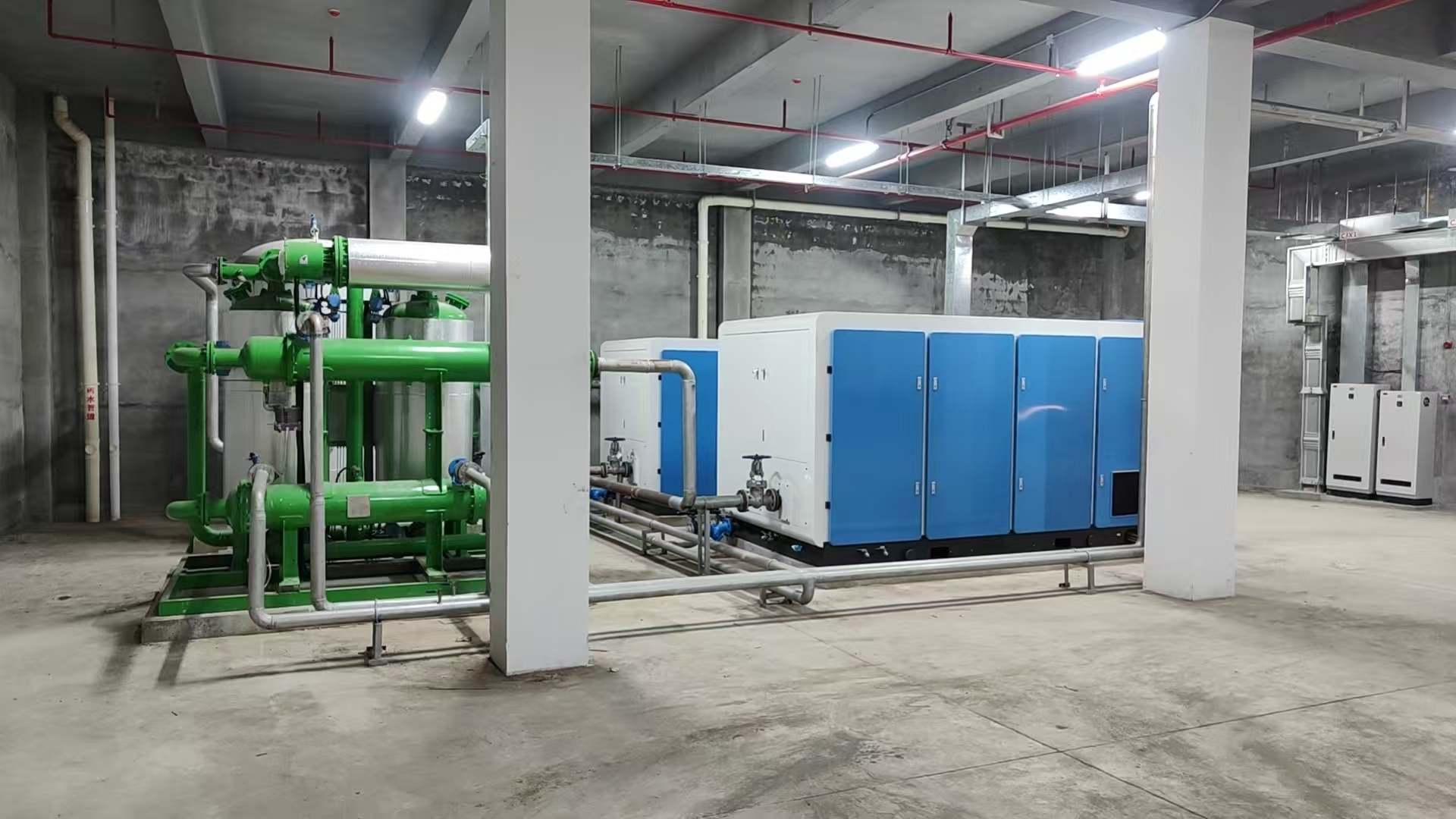
Truly pristine air isn't just about trapping particles. It's a careful blend of physics, chemistry, and smart engineering that goes far deeper than simple mechanical sieving. While filters catch the obvious dust and pollen, the real craft lies in neutralizing the invisible threats—viruses, volatile organic compounds, and microscopic odors that slip right through conventional mesh.
Modern systems shape air quality with precision tools like bipolar ionization, UV-C photocatalysis, and electrostatic precipitation, each method quietly dismantling contaminants at a molecular level. Rather than just collecting pollutants, these approaches break them down or render them harmless. The air that reaches the room isn't merely strained; it's reconditioned, almost as if it's been freshly blended for the space it fills.
Delivery itself becomes an art when you design airflow paths that avoid dead zones, maintain serene quietness, and respond in real time to occupancy patterns. There's a rhythm to how air moves through a well-tuned system—a soft, persistent drift that wraps a room without stirring dust or creating drafts. It's this orchestration of technology and subtlety that turns contaminant-free air from a basic need into an invisible luxury.
Inside the Cleanroom: Compressor Design for Sub-Nanometer Processes
Compressor design for sub-nanometer processes transcends conventional engineering. Within a cleanroom, every micron of vibration and trace of contamination can distort atomic-scale precision. The compressor must operate with near-zero particulate emission while maintaining ultrastable pressure control, often achieved through magnetically levitated bearings and oil-free compression mechanisms. Materials are selected not just for durability but for outgassing properties, ensuring no airborne molecular contamination reaches the process chambers.
Thermal management becomes a silent battleground. Even minor temperature fluctuations can expand components, altering alignments critical for sub-nanometer lithography. Dynamic cooling systems integrated into the compressor housing counteract this, using predictive algorithms that adjust coolant flow microseconds before a thermal spike occurs. The result is a thermal drift so slight it escapes detection by standard metrology tools.
Beyond the hardware, software plays a decisive role. Adaptive control systems monitor vibration signatures in real time, adjusting parameters to avoid resonance frequencies that could propagate through the facility’s subfloor. This is not simply a compressor; it is a cyber-physical system that learns the cleanroom’s unique acoustic profile and protects the delicate processes inside.
When Air Becomes a Critical Raw Material
For most of human history, air was the ultimate free resource—invisible, abundant, and taken for granted. But the industries shaping our modern world have quietly transformed this atmospheric mixture into a coveted feedstock. From the oxygen that fuels steel furnaces to the neon glowing in our fiber-optic networks, the gases we once thought of as mere empty space now form the backbone of manufacturing, medicine, and technology.
Extracting value from thin air might sound like alchemy, yet it happens every second in colossal cryogenic plants that chill the atmosphere until it liquefies and surrenders its components. Each gas has found its niche: argon shields welds from contamination, helium cools MRI magnets, and krypton fills double-pane windows to boost insulation. The supply chains for these invisible commodities are surprisingly brittle—a single disruption at a separation unit can ripple through semiconductor fabs, hospitals, and food packagers worldwide.
What’s truly startling is how geopolitical tensions have thrust air-derived materials into the spotlight. Rare gases like xenon and neon, once byproducts of steel-making concentrated in a handful of regions, are now strategic assets. When conflicts limit access, the cost of breathing life into tech products skyrockets, reminding us that even the air we breathe has become a battleground for critical resources.
Precision Breathing: The Lifecycle of Semiconductor-Grade Air
Inside every leading-edge fab, the air itself is a manufactured product—no less critical than the silicon wafers it surrounds. Imagine the cleanroom as a living lung, inhaling and exhaling with metronomic precision. Each breath moves colossal volumes of air through a vertical unidirectional cascade, sweeping away particles as small as a few nanometers. This isn’t mere ventilation; it’s a choreographed lifecycle where outdoor air is never simply “pulled in.” Instead, it’s drawn through a gauntlet that strips away dust, moisture, trace gases, and even temperature variances. The goal? A static, chemically inert atmosphere so pure that a single errant molecule can become process sabotage.
The journey begins at the make-up air handler, where ambient air is scrubbed of macroscale debris before passing through banks of high-efficiency filters and chemical adsorbers. Ammonia, siloxanes, sulfur compounds—enemies to lithography and epitaxy—are trapped by specialty media, leaving concentrations measured in parts per trillion. Thermal wheels and chilled-water coils then nudge the air to a tightly controlled temperature and humidity band, often within ±0.1°C and ±0.5% RH. This pre-conditioned air merges with the dominant recirculation stream, where fan filter units—deployed in the thousands across the ceiling—impart the final polish through ULPA membranes. What enters the photolithography bay is not simply ‘clean’; it’s engineered to suppress airborne molecular contamination to levels that won’t distort a 5nm line.
Yet the most remarkable aspect is the air’s cyclical economy. Less than 5% of the total airflow is typically exhausted; the rest is drawn back into the raised floor plenum, passing through return air shafts and chemical filters again and again. This loop can recirculate the entire fab’s volume up to 600 times per hour, making energy demand staggering. Smart sensors now monitor particle counts and AMC in real time, dynamically adjusting fan speeds and damper positions—essentially changing the lung’s rhythm to match process needs without wasting power. In this context, the lifecycle of semiconductor-grade air becomes a story of renewal, not disposal. It’s a perpetual, fine-tuned breath that defines the boundary between nanoscale perfection and failure.
From Intake to Wafer: A Journey Through Zero-Defect Compression
The transformation begins the moment raw materials enter the facility. Every shipment undergoes rigorous inspection protocols that leave no room for variability. Advanced spectrometry and material analysis tools verify composition and purity before anything moves to the next stage. This intake checkpoint acts as the first barrier against potential defects, ensuring only materials that meet strict specifications proceed. The philosophy is simple: a flawless wafer starts with flawless inputs.
Once materials pass intake, they move through a tightly controlled series of shaping and refinement steps. Machining and chemical processes are monitored by in-line sensors that detect deviations measured in nanometers. Unlike traditional methods that rely on post-processing checks, this approach embeds quality verification directly into the workflow. Operators and automated systems work in tandem, making real-time adjustments that keep every dimension, surface finish, and crystal orientation within an exceptionally narrow tolerance band.
The final leap from processed substrate to finished wafer is where compression of the zero-defect mindset truly manifests. Final inspection employs multi-angle optical scanners and electron microscopy to scan the entire surface, hunting for irregularities invisible to the human eye. Every wafer that leaves the line carries data from its entire production journey—traceable, verifiable, and certifiable. It’s not just about catching defects; it’s about designing a system where defects have no place to exist.
FAQ
In semiconductor fabrication, even microscopic contaminants can ruin chip wafers. Ultra-clean compressed air ensures that processes like photolithography, etching, and wafer handling remain free from oil, moisture, and particles, directly impacting yield and precision.
Through multi-stage filtration, oil-free compression technology, and advanced dryers, air is scrubbed to ISO 8573-1 Class 0 standards. Continuous monitoring with particle counters and dew point sensors ensures compliance, while regular audits confirm no contamination.
Unlike general industrial units, these systems eliminate all oil vapors, use electropolished stainless steel piping to prevent particulate shedding, and incorporate vibration isolation to avoid disturbing sensitive equipment. Every component is selected for outgassing and chemical compatibility.
Absolutely. Factories work with fabs to design fully integrated packages—from intake filtration to point-of-use polishing—matching ISO cleanliness levels, flow rates, and even specific inert gas blending. Custom control panels allow seamless integration into facility management systems.
The compression cycle generates significant heat, and recovering it can reduce a fab’s overall energy footprint. Smart factories often feed recovered heat back into HVAC or process water loops, turning a utility cost into an operational efficiency gain without compromising air quality.
Predictive maintenance using IoT sensors tracks vibration, pressure differentials, and motor currents. Filter change intervals are condition-based, not calendar-driven, and comprehensive teardown inspections are scheduled only when performance data suggests it, minimizing downtime in 24/7 operations.
Conclusion
In semiconductor fabrication, compressed air is not merely a utility but a critical raw material whose purity defines wafer yields. The air compressor factory operates at the intersection of precision engineering and contamination control, crafting an invisible yet indispensable resource. Every cubic meter of air must be stripped of particles, moisture, and volatile organic compounds to levels measured in parts per trillion, for even a single microscopic contaminant can render an entire batch of chips defective. This ultra-clean air breathes life into photolithography, etching, and wafer handling tools, where it directly contacts surfaces measured in angstroms. The compressor design itself must be a cleanroom-compatible masterpiece, with oil-free mechanisms, electropolished surfaces, and sealed pathways that prevent any backstreaming of impurities. In this realm, air is refined to an art form, embodying the factory’s commitment to zero-defect manufacturing for sub-nanometer processes.
The journey from intake to wafer is a disciplined lifecycle that begins with ambient air and ends as semiconductor-grade breath. Multi-stage filtration cascades remove particles down to virus-scale dimensions, while catalytic converters and adsorption dryers eliminate chemical residues and humidity fluctuations. Sensors monitor purity in real time, ensuring that the compressed air remains within the strict tolerances demanded by leading-edge fabs. This invisible delivery system is the backbone of contamination-free environments, where even the air itself must not introduce variability. By treating air as a strategic asset, the compressor factory enables the relentless scaling of microelectronics, turning an abundant atmospheric resource into a precision fluid that shapes the yields of tomorrow’s chips.
Contact Us
Contact Person: Mia
Email: [email protected]
Tel/WhatsApp: +86 19821985894
Website: https://www.seize-air.com