
OEM Sanitary Ware Vertical Lift Plating Equipment for Superior Electroplating Results
2026-11-02
Uneven chrome, trapped solution, and high reject rates—these are the daily struggles of OEM sanitary ware manufacturers using horizontal plating lines. Junda's vertical lift plating equipment flips that dynamic, using gravity as an ally to deliver superior electroplating results on every faucet body, shower head, and drain. In this post, we'll explore why this technology is gaining traction among manufacturers who can't afford to compromise on finish quality.
Why Vertical Lift Plating Suits Sanitary Ware Better
Sanitary brass components rarely have simple geometries. Faucet bodies, thermostatic cartridges, and shower mixers contain recessed chambers, narrow inlets, and intersecting waterways that easily trap air or retain solution during horizontal plating. Vertical lift plating keeps these parts suspended so the bath can flow through internal cavities more predictably, and the up-and-down motion helps dislodge hydrogen bubbles that would otherwise cause pitting or dull patches. This becomes even more critical with multi-layer nickel-chrome systems, where a single shadowed area on a semi-bright deposit will show through the final mirror finish.
The method also reduces mechanical damage compared with barrel or horizontal rack lines. Each sanitary fitting is held on its own fixture, so there is no tumbling or part-to-part contact that can create micro-scratches before the chrome layer is applied. Because the lifting speed and dwell time can be fine-tuned for each bath, operators gain better control over thickness distribution in low-current-density areas such as deep outlet threads or valve seats. As a result, the coated parts consistently pass long-hour neutral salt spray tests without flaking or rust bleeding from hidden zones.
On the production floor, vertical lift lines handle heavier, bulkier sanitary castings without sagging or shifting the rack. The straight vertical travel also lets excess solution drain back into the tank more efficiently than angled or horizontal paths, reducing drag-out volume and lowering wastewater treatment loads. Loading and unloading at a fixed height is less strenuous for workers, and the simple, repeatable motion makes automation easier to maintain. For manufacturers producing high-end bathroom fittings, that balance of surface quality and line reliability is difficult to achieve with other racking orientations.
OEM Configurations That Adapt to Your Shop Floor
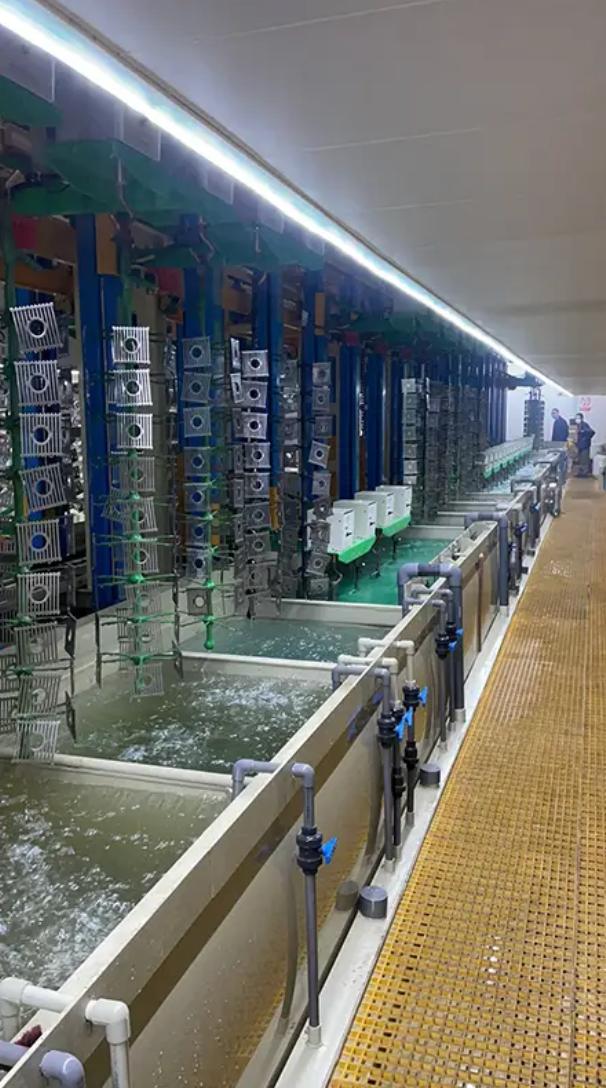
Every shop floor carries its own set of constraints—aisle widths that were never meant for modern equipment, legacy controllers that still run a third of the line, and shift patterns that leave little room for lengthy changeovers. An OEM configuration that actually fits starts with a floor walk, not a spec sheet. Mounting brackets get repositioned, sensor ranges are recalibrated for the dust or vibration already present, and interface panels are simplified to match what operators already know. The result is a system that slots into the existing rhythm instead of demanding a new one.
Adaptation also shows up in how the control logic handles edge cases. A standard cycle time assumes parts arrive clean and oriented; your line might not offer that luxury. By letting individual stations hold a queue of two or three pieces and adding a soft-stop sequence for jammed tooling, the configuration absorbs the everyday mess without triggering a full halt. These aren't add-on features—they're built into the base parameter set so a maintenance tech can adjust them with a passcode, not a vendor call.
The value of OEM adaptation becomes clearest during a product changeover. Instead of re-teaching every camera and swapping out mechanical guides, the machine pulls a stored recipe that includes conveyor speed, gripper pressure, and even the angle of a blow-off nozzle. Operators load the new recipe, run a single test piece, and the floor is back to full throughput in under twenty minutes. That kind of flexibility keeps the equipment relevant long after the original purchase order is filed away.
Drainage and Rinsing Advantages You Can Actually See
Most colanders promise drainage but leave you with a soggy pile of pasta or lettuce that still drips all over the counter. This design flips that entirely — the wide, angled slots let water rush out in seconds, so what you lift out actually stays firm and dry to the touch. No more shaking the basket, no more waiting over the sink, just a clean separation between food and water that you can watch happen with every use.
Rinsing is where it gets even more obvious. The raised feet keep the colander stable in the sink while you run water through quinoa, berries, or canned beans, and the spread-out holes mean the water hits every surface evenly instead of pooling in one corner. You can see the cloudy starch or grit washing away, leaving the food bright and loose — not clumped together or half-submerged at the bottom.
The real difference shows up when you dump everything onto a plate: no puddle underneath, no last-second splash from a hidden pocket of water. The colander doesn't just drain — it leaves the food exactly where it should be, ready to season or serve. That's the kind of visible result that makes you reach for this one every time instead of whatever old plastic basket is buried in the cabinet.
Electroplating Bath Control for Repeatable Chrome Finishes
Keeping a chrome bath within a narrow window is less about chasing a single magic number and more about managing the interplay between chromic acid concentration, sulfate ratio, and temperature. When the sulfate climbs too high relative to chromic acid, deposits turn milky in low-current areas and lose their bite. Dropping below the ideal 100:1 chromic acid-to-sulfate ratio pushes the bath toward burning, especially on edges and high-current-density zones. A weekly titration for both chromic acid and sulfate beats relying on vendor-supplied correction charts, because drag-out rates and mist suppressants can quietly skew the numbers. Small, frequent additions beat large corrections: a bath that swings from 220 g/L to 280 g/L chromic acid will never plate the same way two days in a row.
Temperature and current density deserve equal attention. The classic 45–50 °C range works for many decorative lines, but raising the temperature to 55 °C can improve covering power only if the current density follows—otherwise the deposit turns soft and dull. Watch for ripple from aging rectifiers; a chrome bath has no tolerance for inconsistent current, and repeatable finishes often start with a stable power supply, not a bath addition. Finally, don't ignore trivalent chrome buildup. Levels above 2–3 g/L narrow the bright range and force you into higher temperatures and lower current densities just to stay out of the haze. A steady bleed of fresh solution, combined with Hull cell panels every shift, gives you a much earlier warning than waiting for rejects at final inspection.
Fewer Masking Errors with Purpose-Built Fixtures
Masking mistakes often creep in when operators rely on tape, plugs, or makeshift covers that don't quite match the part profile. A purpose-built fixture removes that guesswork by aligning directly with the component's geometry, so every edge, hole, or threaded area that needs protection is covered the same way each time. The result is a drastic drop in rework caused by overspray, coating bleed, or missed areas.
Instead of forcing a generic solution onto a complex shape, these fixtures are machined or molded to hold the part in a repeatable position while shielding only the surfaces that must stay clean. That precision means fewer judgement calls on the floor, less variation between shifts, and a more consistent finish from first article to final production run.
Engineered fixtures also speed up the overall process. Operators spend far less time cutting tape, pressing in plugs, or checking for leaks before coating begins. Over a full production cycle, that efficiency compounds, and the drop in masking-related defects directly improves first-pass yield without adding extra inspection steps.
Automated Hoist Moves That Keep Orders Flowing
In a busy fulfillment center, the difference between on-time shipping and a missed cutoff often comes down to how quickly totes and cartons travel between picking, packing, and sortation. Automated hoists handle that vertical and horizontal transfer without the hesitation or fatigue that creeps into manual moves. Instead of waiting for a forklift or a tugger, each order container rides a dedicated lift to the exact mezzanine or conveyor spur it needs next.
What makes these hoist moves reliable is less about raw speed and more about consistent timing. The controller tracks every carrier position and releases each load only when the downstream station signals capacity. That handshake removes the stop-and-go bottlenecks that used to pile up at receiving docks and packing lines. Operators no longer radio for assistance when a bin is stuck on the wrong level; the system simply reroutes it through the nearest open drop point.
The result is a quieter flow where orders keep moving even during shift changes and peak surges. Maintenance teams also benefit from condition monitoring on drive belts, brakes, and guide rails, so small issues get flagged before they interrupt the line. Over time, this kind of automated transport turns what was once a routine material-handling chore into an almost invisible background rhythm.
FAQ
Sanitary fittings often have deep recesses and tight angles. The vertical movement pattern lets parts enter and exit baths at a steady angle, which reduces air pockets and solution carry-over. You get a more uniform deposit inside threaded areas and around spout edges than with horizontal barrel or rack lines.
Yes. The OEM aspect means the frame length, tank dimensions, number of process stations, and even the lift stroke can be adjusted to match your floor space and workpiece size. We usually start with a technical survey of your current line before proposing the final configuration.
Brass faucet bodies, shower heads, valves, towel bars, drains, and other zinc or stainless trim pieces are all common. The plating racks are designed to hold multiple parts per flight bar, with contact points placed where marks won't affect visible surfaces.
Because the work moves straight up and down instead of following an arc, the distance between anodes and parts stays more constant. Combined with adjustable hoist speed and pause time at each station, this keeps nickel and chrome layers within a tighter tolerance across the whole load.
It can be set up with multiple flights moving in sequence and automatic loading/unloading zones. Depending on your tank volume and rectifier capacity, a single line can handle several thousand pieces per shift without sacrificing plating quality.
You can run copper, nickel, and chromium baths for traditional polished finishes, or add satin and matte effects by adjusting pretreatment and plating parameters. The line can also accommodate gold or other decorative top coats if you include the appropriate stations and rinses.
The vertical lift reduces drag-out because parts drain more completely while hanging vertically. Still, we include spray rinses above the tanks, drip trays, and bath chemistry recovery stations where needed. The control system also tracks drag-in and drag-out to help you keep bath purity stable.
Beyond commissioning and operator training, we provide process recipes for common sanitary alloys, troubleshooting guides, and remote diagnostics. Spare anodes, racks, and pump components can be shipped quickly, and we can send a technician for on-site fine-tuning if your product mix changes.
Conclusion
Plating sanitary ware comes with unique demands: deep contours, hidden recesses, and the need for a flawless chrome finish on every visible surface. Vertical lift equipment handles these challenges more cleanly than horizontal barrel or rack lines because parts are suspended and moved through the process with better solution contact and drainage. When you choose an OEM build, the layout is not forced into a standard footprint—tank sizes, flight bar spacing, and load capacity are all matched to the actual parts you run daily. One immediate benefit is the way rinse water and drag-out behave. Vertical orientation lets liquids sheet off quickly instead of pooling in concave areas, so cross-contamination between baths drops and you spend less time correcting rinse quality. This also means fewer water marks and haze after chrome plating, which keeps rework rates low.
Consistent electroplating results depend on tight bath control. OEM vertical lift systems can be designed with dedicated circulation, filtration, and heating or cooling loops for each process tank, so the chrome bath stays within a narrow operating window shift after shift. Purpose-built fixtures take the guesswork out of masking and racking; parts are positioned the same way every cycle, which reduces operator errors and improves first-pass yield. On the handling side, automated hoist movements follow programmed sequences that keep transfer times short and steady, so a hot rinsing step does not cool down before the next bath. The result is a line that holds its rhythm from morning startup to final unload, helping your shop maintain throughput without sacrificing the deep, even chrome finish sanitary ware buyers expect.
Contact Us
Contact Person: hayyr
Email: [email protected]
Tel/WhatsApp: 8613082110525
Website: https://www.jundaelectroplating.com