
Full Automatic Sanitary Pad Machine: Revolutionizing Production Efficiency
2026-09-20
Sanitary pad production has long been hindered by slow, labor-intensive processes that cap output and inflate costs. The shift to fully automatic systems is changing that equation overnight. At the forefront of this shift is Womeng, a brand pushing the boundaries of what automated manufacturing can achieve. By eliminating manual bottlenecks and enabling continuous high-speed operation, Womeng's machines are redefining what efficiency means on the factory floor. In this blog, we take a close look at how full automatic sanitary pad machines are transforming production—and why the right machinery partner makes all the difference.
The End of Stop-and-Go Production
The phrase stop-and-go production has long described a factory floor where batches pile up, machines idle, and workers wait for the next step. It shows in uneven output numbers and constant schedule revisions. Moving past that mode is not about a single tool; it is a shift in how work is sequenced and paced.
One of the most visible changes is the removal of large buffer inventories between stations. When parts move directly from one operation to the next, problems surface quickly instead of hiding inside a pile of work-in-process. Teams learn to solve small disruptions before they ripple into the entire line. This often means rethinking machine layouts and shift routines, not just tweaking a few timers.
The payoff appears slowly at first, then all at once. Lead times shrink, floor space opens up, and quality conversations become more direct because defects are caught closer to their source. More importantly, a flow-based line gives management a truer picture of capacity, making it easier to spot real bottlenecks rather than guessing from a spreadsheet.
Where 800 Pads Per Minute Is Just the Baseline
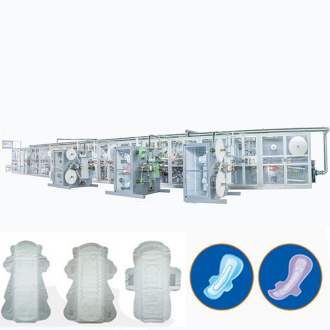
On many converting lines, hitting 800 pads per minute is treated as a ceiling. Here, it is simply where the real work begins. The servo-driven cores and tension controls are tuned to hold that pace without web breaks or adhesive bleed, so operators spend less time chasing faults and more time dialing in the next increment.
The difference shows up in the unwind stands and the reject bins. Running at baseline speed means the splices, the ultrasonic bonding, and the fold registration all have enough headroom to stay stable when material rolls vary. Instead of pushing the machine to its limit just to meet a shift target, the line cruises at 800 and leaves room for the moments when demand spikes or a new core size tests the setup.
Why Less Human Touch Means Fewer Defects
Every time a person handles a component, the odds of contamination, misalignment, or subtle damage go up. Even with gloves and cleanroom protocols, fingertips can leave residue, introduce static, or apply uneven pressure that shifts delicate parts out of tolerance. By cutting back on manual steps, production lines remove a whole category of errors that no amount of training can fully eliminate.
Automation doesn't get tired, distracted, or rushed near the end of a shift. A robotic arm repeats the same motion with the same force thousands of times, while a human operator naturally varies from one cycle to the next. That consistency is especially valuable in electronics assembly, optical alignment, and medical device manufacturing, where a fraction of a millimeter can mean the difference between pass and fail.
Less direct contact also means fewer opportunities for cross-contamination between batches. When tools and fixtures handle materials instead of hands, the risk of transferring oils, skin cells, or particles drops sharply. The result is a cleaner process with fewer defects traced back to handling, and a more predictable yield from the first run to the last.
Changeovers That Used to Eat a Shift Now Take a Coffee Break
Line 4 used to be the bottleneck every Tuesday. The switch from the 12-ounce jar to the 16-ounce meant draining the filler, swapping out a dozen change parts, and re-aligning the capper. A fast crew could knock it out in ninety minutes. Most took closer to three hours, and the first case off the line usually ended up in the reject bin.
Now the same changeover happens while the operator grabs a coffee. Quick-release clamps, preset rail positions, and a tool-less star wheel swap cut the mechanical work to fifteen minutes. The rest is just a recipe on the HMI: call up the product code, let the line run its purge cycle, and confirm the first weight check. No shims, no trial-and-error, no overtime.
The real difference isn't just speed. It's that changeovers stopped being a scheduled event and became a pause between runs. A line that used to lose nearly a full shift per week to setup now loses about the time it takes to finish a latte. That time goes back into production, or into maintenance, or into letting the crew leave on time for once.
Automation’s Quiet Win Is Cutting Waste, Not Just Labor
In many plants, the obvious story about automation is fewer hands on the line. But the less visible payoff shows up in the scrap bins. Sensors and adaptive controls trim excess material, catch defects before a full batch runs, and adjust temperatures or speeds by fractions that add up to thousands of pounds of saved raw inputs.
Warehouses and logistics offer another angle. Automated picking and packing systems can shrink packaging to the smallest workable size, reduce double-handling, and route shipments with fewer empty miles. That cuts corrugated cardboard, fill material, and fuel use—waste that rarely made it onto a spreadsheet before.
Perhaps the biggest shift is in mindset. Once companies see automation as a way to remove waste rather than just replace people, they start asking different questions: Where does material disappear? Which steps produce no value? The answers often point to quiet, unglamorous fixes that improve margins without any headcount change at all.
Scaling Output Without Adding a Single Square Foot
Most operations assume growth starts with a bigger footprint, but that's rarely the cheapest or fastest path. The real lever is often hidden in how existing space is used—rethinking layout, shift patterns, and material flow can unlock capacity that was always there. One plant added a second mezzanine level for light assembly and boosted throughput by a third without moving a wall.
A closer look at idle time typically reveals the next gain. Machines waiting on parts, workers walking long distances for tools, staging areas that turn into clutter—each one quietly caps output. Tightening those loops doesn't require a new building; it requires treating every square foot as a production asset instead of a storage afterthought. The trick is to measure cycle times by zone, not just by machine.
When physical space can't grow, the bottleneck usually moves to scheduling. Compressing changeovers, running smaller batches more frequently, and cross-training staff so no station sits idle can feel disruptive at first. But those adjustments compound. A warehouse that re-slotted its top 200 SKUs by velocity cut picking travel by nearly half, adding capacity without a single new rack.
FAQ
It integrates unwinding, core forming, pulp crushing, SAP application, gluing, and packaging into a continuous servo-driven line, so operators no longer need to transfer semi-finished pads between stations.
Depending on pad size and complexity, a well-tuned line can run at 800 to 1,200 pieces per minute while maintaining consistent weight and seal integrity.
The machine is designed for nonwoven topsheet, ADL, wood pulp or fluff, superabsorbent polymer, PE film, and release paper, all fed from unwinders with low-tension control to avoid stretching or tearing.
Many models use servo-driven sizing modules and recipe-based HMI settings, letting operators switch between length, width, and absorbency profiles in under 15 minutes without changing mechanical cams.
Vision cameras and ultrasonic sensors check SAP distribution, edge sealing, wing folding, and final length, automatically rejecting out-of-spec units before they reach packaging.
Centralized lubrication points, quick-release wear parts, and remote diagnostics allow scheduled stops to be short and targeted, while predictive alerts flag roller or belt fatigue before failure.
Labor savings, lower scrap rates, faster changeovers, and higher throughput typically pay back the investment within 18 to 24 months in high-volume markets.
Conclusion
The days of herky-jerky, stop-and-go sanitary pad lines are over. A full automatic machine runs continuously, not in fits and starts, so the production floor stops feeling like a traffic jam during shift change. At 800 pads per minute, that is just where the conversation begins — newer configurations push beyond it without sacrificing cut accuracy or seal integrity. Because raw materials move through forming, folding, and wrapping with almost no direct human handling, the usual sources of contamination and misalignment fade away. Operators are not fixing jams or adjusting tension mid-run; they are watching diagnostics and planning the next batch. That shift alone changes what 'normal' looks like for a line that used to demand constant intervention.
Changeovers that once ate up half a shift now happen during a coffee break, thanks to recipe-driven settings and automatic core positioning. But the quieter win is how much waste gets eliminated — not just labor hours, but raw material trim, rejected pads, and plastic film overruns. When every sensor and servo works from the same timing, the line stops overproducing scrap and starts producing saleable units. Meanwhile, scaling output no longer means clearing out another bay. The same footprint can handle multiple lanes or higher cycling rates because vertical integration and smarter servo control pack more throughput into the same steel frame. It is a rare case where efficiency, quality, and floor space all improve at once.
Contact Us
Contact Person: Jessie Lai
Email: [email protected]
Tel/WhatsApp: 86-188594442931
Website: https://www.wm-machinery.com