
Econom Press Brake Company: Precision Press Brake Solutions for Modern Metal Fabrication
2026-10-02
Precision metal fabrication isn’t just about having the right press brake—it’s about having a system that holds tolerance hour after hour. Econom Press Brake Company has built its reputation on exactly that, and with HUNSONE tooling at the core, their solutions push modern fabrication from ‘close enough’ to ‘exactly right.’ Here’s how.
How Econom Press Brake Achieves Repeatable Bending Accuracy
Repeatable bending accuracy in an Econom press brake starts with the machine's rigid frame and precision-ground tooling interfaces. The upper beam and lower bed are machined as a matched set, minimizing deflection under full tonnage. This structural stiffness ensures that every bend cycle begins from the same geometric reference, so even small variations in material thickness or grain direction don't compound into angular drift.
Beyond the iron, the hydraulic system uses closed-loop position feedback on both cylinders. Independent linear encoders track ram position in real time, and the controller constantly adjusts oil flow to keep the beam parallel to the bed within a few microns. That synchronization is what allows you to run a batch of fifty parts in the morning and fifty more after lunch without touching the bend angle – the ram returns to the same depth every stroke, not just approximately, but measurably.
Then there's the angle correction logic built into the control. After the first bend, a sensor or the operator measures the actual resulting angle, and the software nudges the target position to compensate for springback and tool deflection. It's not a one-size-fits-all offset; the correction curve adapts to the specific material grade and bend length you're running. That means the second part comes out right, and the rest of the run stays consistent without constant manual tweaking.
Machine Configurations Built Around Your Production Floor
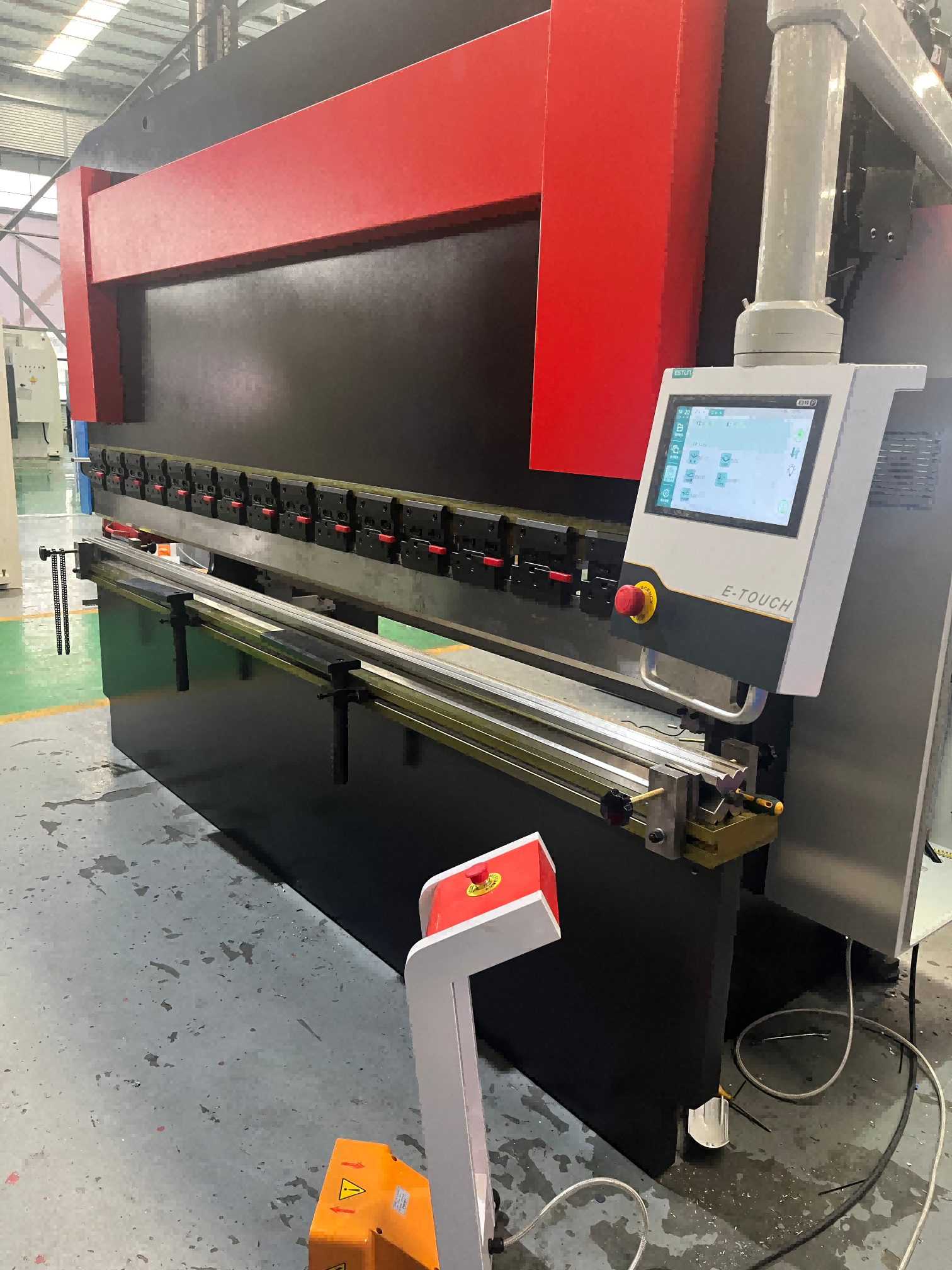
Rather than forcing your floor to adapt to a fixed machine frame, the configuration starts with how your operators actually move through the space. Load height, conveyor direction, control panel placement, and even the side where scrap exits can be shifted before the unit leaves the factory. That means the machine sits naturally within existing walkways instead of creating new bottlenecks.
Where columns, low ceilings, or existing utilities break up the floor, the frame can be split into modules that reassemble around those obstacles. Access panels and cable entry points are repositioned to the least disruptive side, so routine maintenance doesn't require shutting down neighbouring cells or moving heavy tooling across the plant.
The real benefit shows up in material flow. When the intake side lines up with your upstream equipment and the discharge points toward the next operation, parts move in one continuous direction. Forklift traffic drops, operators spend less time crossing paths, and multiple stations can be run by a smaller crew without the usual back-and-forth.
Tooling and Automation That Cut Setup Time in Half
For years, our changeovers started with a wrench and a prayer. Operators would loosen six T-nuts, tap a vise with a dead-blow hammer, and then spend twenty minutes chasing zero. That ritual ended the week we swapped to a zero-point clamping plate and pre-set tool holders. Now the same fixture drops onto four hardened locators, clicks once, and is repeatable within a tenth before the door even closes.
The real time savings came from automating the smaller decisions. We mounted RFID chips on every tool holder, so the machine reads length and diameter offsets the moment a tool touches the spindle. A barcode scan at the control pulls up the correct program, work offset, and probing routine. No more keying in numbers at 6 a.m. or hoping the night shift left a legible note. Setup data travels with the job, not with someone's memory.
On a typical 30-part run, we used to lose 45 minutes to setup. That number is now 16, and it stays there because the process doesn't depend on who is doing it. The spindle turns sooner, the first article comes out closer to size, and the biggest argument on the floor is whose turn it is to sweep up chips.
From Prototype to High-Volume: Real Workshop Applications
Many workshops start with a single prototype, often hand-built and riddled with trial-and-error fixes. The real challenge emerges when that one-off part needs to become a thousand identical units. Processes that worked fine on a manual mill suddenly show their limits: tool life drops, cycle times climb, and operators spend more time adjusting than cutting. The transition isn't just about buying faster machines; it's about rethinking fixturing, toolpath strategy, and quality checks so that the process remains stable when the order quantity jumps from three to three hundred.
In practical terms, this often means moving from soft jaws and improvised clamps to dedicated hydraulic or pneumatic fixtures that reduce setup variation. It also means auditing each operation for bimetal contact, chip evacuation, and repeatability of tool offsets. Small changes like switching to a more rigid boring bar or adding a quick-change tooling system can shave minutes per part without touching the spindle speed. Workshops that thrive at scale treat every prototype decision as a candidate for redesign—not because the prototype was wrong, but because high-volume production rewards predictability over cleverness.
The most successful shops we've visited keep a running log of what failed when they pushed a prototype into production. That log becomes a checklist for the next job: check for thin-wall deflection on part number two, verify coolant pressure reaches the insert at full depth, simulate the toolpath with actual rough stock dimensions. None of this requires a massive investment in automation. It requires treating high-volume work as a distinct discipline, one where the skill lies in designing processes that don't need constant human intervention. The prototype proves the part can be made; the production run proves it can be made repeatedly, with the lights on or off.
The Service and Support Behind Every Econom Machine
From the moment an Econom machine reaches your facility, you're never left to figure things out on your own. Our service engineers aren't just troubleshooters; they're trained to understand your specific production flow, so adjustments and maintenance feel like a natural extension of your own team's work. Whether it's a routine calibration or an unexpected hiccup, we schedule visits around your uptime, not ours.
Support goes beyond the phone line. Every Econom installation comes with direct access to regional specialists who know the quirks of local materials and operating conditions. When you need a spare part or a second opinion on process settings, you're talking to someone who has seen your challenge before—and probably solved it under worse conditions. That kind of familiarity shortens downtime in ways a generic helpdesk never could.
Long-term ownership is where the real difference shows. We keep detailed service records for each unit, so no one has to re-explain your machine's history. Training for your operators is available whenever you expand or shift production, and our field teams often catch small issues before they become expensive failures. It's not about being reactive; it's about standing behind every machine we build, from first start-up to final decommission.
Why Fabricators Switch to Econom for Complex Forming Jobs
Complex forming jobs tend to expose the limits of conventional stamping equipment pretty fast. Springback, thinning, and wrinkles stop being minor annoyances and become real scrap drivers once you push into deep draws, tight radii, or mixed material stacks. Econom’s servo-driven presses and in-house simulation give fabricators a way to see material flow before the first hit, which usually means fewer trial dies and a much shorter runway from print to production.
The difference also shows up in how tooling gets treated. On difficult geometries, a standard press might chew through dies because the ram motion is fixed. Econom adjusts stroke profiles, dwell times, and cushion pressure to match the part’s specific forming window. That keeps wall thickness more uniform and prevents the kind of localized stretching that leads to cracks in high-strength steel or aluminum alloys.
Once a shop moves its complex work over, the scrap rate usually drops fast, and tool maintenance stops being a weekly fire drill. The real payoff, though, is being able to take on jobs that competitors won’t quote. Econom’s quick-change setups also mean smaller batch sizes are actually profitable, so fabricators aren’t stuck waiting for a huge order to justify a complex part run.
FAQ
Econom builds both hydraulic and servo-electric press brakes, ranging from compact 40-ton units for small job shops to 800-ton machines for heavy plate work. The servo-electric models are particularly popular with shops trying to cut energy use and noise without sacrificing repeatability.
Depending on the model and tooling setup, you can expect repeatability within ±0.0004 inches on the ram position. The CNC backgauge holds position to ±0.0008 inches, which is tight enough for aerospace and medical device work, not just general fabrication.
Yes. The frames are built with extra-deep side housings and oversized cylinders, so they handle materials like AR400, titanium, and duplex stainless without excessive deflection. We also offer adjustable crowning as standard on machines over 100 tons.
We can supply custom punches and dies, but the machines are also designed around standard American and European tooling styles. Many customers bring their existing Wila or Amada-style tooling and adapt within a day using quick-change clamps.
Every machine ships with a touchscreen CNC that includes offline programming, 3D bend simulation, and automatic bend sequence calculation. It also supports DXF file import, so operators can go from a flat pattern to a finished part without manual angle trial runs.
We provide on-site training, but more importantly, we offer a three-day commissioning program where our technicians actually run your first production parts with your operators. After that, phone and remote diagnostics are free for the life of the machine.
The main difference is that we don't treat options as luxury add-ons. Things like laser safety, LED bend angle measurement, and hydraulic clamping are included on most models. The frames are also welded and stress-relieved in-house, which keeps long-term accuracy stable.
Conclusion
Econom Press Brake Company builds its reputation on machines that hold their angles run after run, not just on paper. That repeatable accuracy comes from a mix of rigid frames, carefully matched hydraulics, and controls that compensate for material springback in real time. But what often convinces shop owners is the way each press brake is configured around the actual floor space, operator habits, and part mix. A small prototype job doesn't need the same guarding or backgauge travel as a high-volume run of stainless brackets, and Econom treats those as different conversations. Tooling and automation get the same practical attention: quick-change clamping, programmable crowning, and robot-ready interfaces trim setup time enough that a shift can move from one job to the next without losing half the morning.
In real workshops, that shows up as one machine stepping from first-article bends to thousands of parts without a rebuild in between. Fabricators who switch to Econom for complex forming jobs often mention the same thing: the machine doesn't fight them on tight radii, deep boxes, or perforated blanks. Support is part of the package too, from installation and training to phone help when a new material behaves oddly. Instead of chasing generic specs, they get a partner that understands bending is not just tonnage and stroke. It's repeatable setups, tooling that stays put, and a company that answers when something goes sideways. That combination is why Econom keeps showing up in shops that have outgrown entry-level equipment but still need a press brake that earns its floor space every day.
Contact Us
Contact Person: James Chen
Email: [email protected]
Tel/WhatsApp: 86 13770803946
Website: https://www.hunsone.com/