

Custom Piezo Ceramic Solutions for Precision Actuation and Sensing
2026-11-02
Precision actuation and sensing live or die by the ceramics hidden inside the system. If you're still forcing standard piezo components into a design that demands something specific, you're leaving performance on the table. Siansonic builds custom piezo ceramic solutions around your actual operating conditions—matching shape, electrode layout, and material response to the frequencies, loads, and resolutions you need. The result is a sensor or actuator that behaves like an extension of your design, not a compromise bolted onto it. In this post, we'll explore how that shift from off-the-shelf to purpose-built changes what's possible.
Why Standard Piezo Ceramics Rarely Fit Precision Motion Control
It is easy to assume any piezo ceramic can be dropped into a precision stage, but most off-the-shelf parts are built for buzzers, ultrasonic cleaning, or low-cost actuators. In those uses, hysteresis, creep, and nonlinearity are tolerated because the goal is simply to move something, not to resolve tens of nanometers. A standard disc or plate may have electrode boundaries and poling uniformity that create asymmetric strain and off-axis tilt. Once you place it under the preload of a flexure guide, those imperfections translate into lost motion and poor closed-loop stability.
Then there is the matter of physical tolerances. Precision motion control depends on flat, parallel surfaces and consistent thickness so the ceramic sits squarely in its mount. Standard ceramics often arrive with sintered surfaces, no grinding or lapping, and electrode wrap-around that is not designed for fine positioning. Shimming a slightly wedged disc or correcting a loose electrical contact adds compliance and hysteresis that the control loop must fight. In the end, the cost saved on the ceramic gets spent on rework and performance compromises.
Drive behavior matters just as much. Materials optimized for high coupling but not for low dielectric loss or stable polarization can heat unevenly under continuous drive. As temperature shifts, displacement drifts, and the actuator's response changes from cycle to cycle. Precision applications need a ceramic with predictable strain vs. field behavior across the operating range, not one that happens to buzz efficiently at a fixed frequency.
Tailoring d33 and g31 Coefficients for Combined Actuation and Sensing
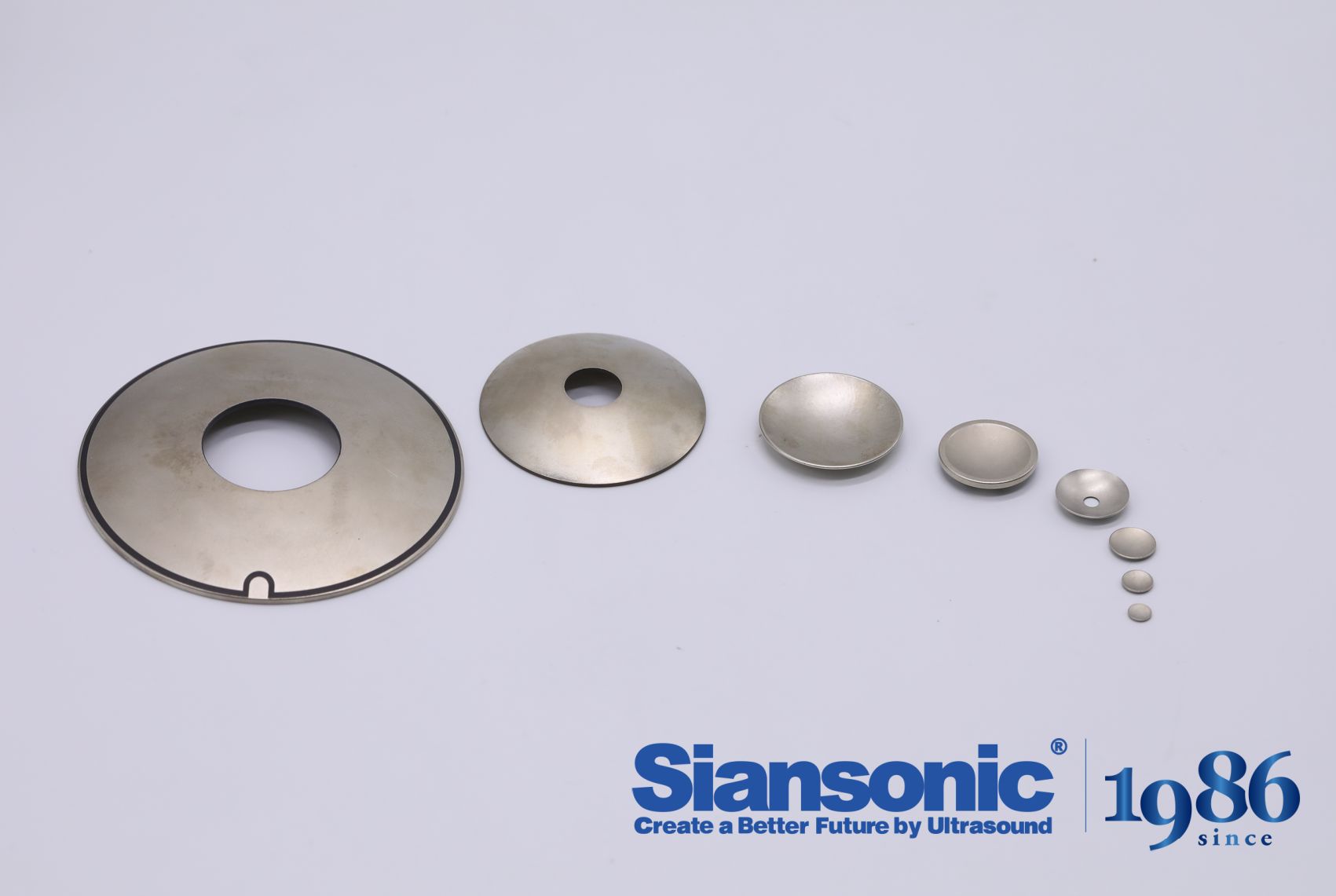
Piezoelectric materials are rarely asked to do just one thing. In self-sensing actuators, energy harvesters that double as structural monitors, or compact medical tools, the same ceramic element must push and listen at once. That demand brings two coefficients into direct tension: d33, which tells you how much strain you get per applied volt, and g31, which sets the voltage produced per unit stress. Most off-the-shelf formulations are optimized for one or the other, so a device designer ends up trading stroke for sensitivity. Tailoring both simultaneously means moving away from generic PZT and looking at composition, microstructure, and poling history as levers that can be pulled together.
Doping is the most direct route. Soft dopants like lanthanum or niobium raise d33 by easing domain wall motion, but they also tend to lower the dielectric constant enough that g31 stays respectable—sometimes even improves if the mechanical quality factor drops in the right way. Hard dopants do the opposite: they clamp domain walls, sacrificing d33 for lower losses, which rarely helps sensing unless the application is high-frequency. Another angle is to work near a morphotropic phase boundary where the polarization vector has more freedom to rotate. A slight tilt in composition or a carefully chosen poling field can push d33 up while keeping the elastic compliance favorable for g31. Grain orientation via templated grain growth also biases the ceramic so that the useful crystallographic directions align with the load axis, giving a more predictable ratio between the two coefficients.
What matters in practice is not chasing absolute maxima for either parameter, but finding a window where actuation force and sensing voltage both meet the system requirement without external amplification. That often means accepting a slightly lower d33 than the best actuator-grade material in exchange for a g31 that is two or three times higher than a typical sensor disc. Some groups achieve this with composite architectures—thin piezoelectric fibers in a soft polymer matrix naturally decouple the longitudinal and transverse responses, letting you tune the effective d33/g31 ratio by changing fiber volume fraction. Others simply repole a standard wafer under different temperature and field profiles, exploiting the fact that remnant polarization and domain texture do not have to be uniform. The result is a material that behaves less like a catalog entry and more like a designed component, shaped around the specific mechanical and electrical boundary conditions of the device.
Stacked Designs that Stay Put After a Million Cycles
If you've ever watched a stacked connector wiggle loose after a few hundred insertions, you know the frustration. The best stacked designs don't just promise repeatability—they prove it by holding alignment through a million cycles without creeping or losing spring force. That kind of staying power comes down to geometry: dual-beam contacts, hardened retention features, and housings that guide each mating sequence into the exact same spot, cycle after cycle.
What separates the truly durable stackers from the rest is how they handle the invisible wear. Instead of relying on friction alone, high-cycle stacked interconnects use pre-loaded contacts that maintain constant normal force even as plating thins. The result is a connection that feels identical on cycle one and cycle one million—no drift, no intermittent opens, no re-seating required in the field.
Embedding Temperature Compensation Directly in the Ceramic
By engineering the material composition itself, the ceramic can be made to respond to temperature shifts in a way that counteracts its own drift. Instead of relying on external circuitry to correct for thermal effects, the compensation is built directly into the lattice. Certain dopants or solid-solution phases introduce a negative temperature coefficient in one parameter that cancels the positive coefficient in another, yielding a net response that stays remarkably flat across a wide operating range. This approach eliminates the need for bulky compensation networks and the power they consume.
The practical impact is significant for devices like resonators, filters, and sensors that must maintain tight frequency or impedance tolerances. Embedding compensation in the ceramic simplifies assembly, lowers part count, and improves long-term stability because there are fewer interconnects and components to age or fail. It also enables operation in high-temperature environments where external compensation electronics would be unreliable. Designers can tune the compensation by adjusting the firing profile or dopant concentration, giving them a direct handle on the thermal behavior without altering the device footprint.
Custom Electrode Geometries for Multi-Degree-of-Freedom Actuators
Electrode design often dictates what an actuator can actually do. Standard parallel-plate layouts tend to limit motion to a single axis, but custom geometries open up far more interesting possibilities. By shaping electrodes into interlocking combs, curved arcs, or offset spiral patterns, you can steer electrostatic forces along multiple directions simultaneously. This allows a single device to produce tilt, lateral shift, and even controlled twisting without adding extra mechanical stages.
One practical approach involves segmenting the electrode surface into independently addressable regions. Instead of applying uniform voltage across one large plate, smaller sub-electrodes can be driven in sequence or with different amplitudes. This creates a traveling electric field that drags a dielectric or conductive mover along a prescribed path. The resulting motion feels less like a simple push and more like a coordinated wave, which is particularly useful for compact actuators that need to fit into tight robotic joints or optical mounts.
Fabrication constraints matter just as much as the theoretical field pattern. Photolithography and laser ablation can handle fine features, but edge roughness and layer misalignment can distort the force profile. Some designs intentionally use tapered electrode widths or asymmetric gaps to compensate for fringing effects, making the actual displacement match the simulated one more closely. Iterating between electrostatic simulation and prototype testing is usually the fastest way to land on a geometry that delivers the intended multi-axis behavior without becoming overly sensitive to manufacturing tolerances.
From Wafer Inspection to Micro-Pumps: One Material Family, Many Tunes
The same ceramic formulation that lets an optical system scan a silicon wafer for hairline defects also flexes the diaphragm inside a compact drug-delivery pump. Piezoelectric materials like lead zirconate titanate can be tuned through dopant ratios, grain size, and poling conditions to favor either high-frequency sensing or high-displacement actuation.
In wafer inspection, thin plates of this material oscillate at kilohertz frequencies to steer mirrors or modulate light with sub-micron angular precision. The low hysteresis and short settling time allow repeated passes over a surface without measurable drift, which matters when a single missed particle means rework or scrap.
Shift to micro-pumps and the same crystal lattice gets configured as a bending actuator. A short voltage pulse makes the disc bow just enough to squeeze a chamber and push fluid through a passive valve. Adjusting layer thickness or electrode layout changes the stroke and force profile, so one base composition can power a stiff, high-pressure pump in a lab-on-chip or a soft, low-flow implantable device. That span, from cleanroom metrology to moving microliters inside the body, shows how much range can be drawn from a single family of perovskite oxides.
FAQ
Custom solutions let you specify the exact ceramic formulation, geometry, electrode layout and mechanical preload to match a particular resonance or displacement profile. Off-the-shelf parts often force you to adapt your system around a generic actuator, which can sacrifice stability or add mass where you least want it.
For high-frequency sensing you typically look at the d33 or g33 coefficients and the mechanical quality factor. A hard PZT formulation tends to give lower losses and a sharper resonance, but if you need broader bandwidth you might choose a softer composition or a composite with a lower Q. We usually run an impedance sweep on a sample disc before locking the final material.
Yes, many formulations can operate continuously above 200°C or down to cryogenic ranges, but you need to specify the full thermal cycle because depoling can occur if you push past the Curie point. We also look at thermal expansion mismatch with the mounting substrate to avoid cracking or delamination.
You should think about stiffness, preload, and the guidance mechanism. Piezo ceramics produce very small strains, so any play or compliance in the fixture will eat into your usable motion. For nanometer-scale control you also need to manage hysteresis and drift, often with closed-loop feedback or charge drive instead of simple voltage control.
Electrode geometry directly shapes the electric field distribution. Split electrodes can create differential bending or localized strain, while interdigitated electrodes on a piezo polymer or composite can boost the effective d33 response along the plane. For sensing, smaller segmented electrodes can improve spatial resolution but reduce overall charge output.
Yes, we regularly build co-fired multilayer stacks for lower drive voltage and higher force, and bimorph or trimorph benders for larger displacement at lower stiffness. The choice depends on whether you need blocking force or deflection, and how much voltage your driver can supply.
A typical custom project takes four to eight weeks from drawing approval to shipment, but that can stretch if you need unusual electrode metallization or a new ceramic formulation. Prototype quantities usually move faster because we can use existing tooling and adjust the machining steps.
We use a combination of laser vibrometry, capacitance gauges, and long-term cycling tests to measure displacement repeatability and drift. For sensing, we track sensitivity drift over temperature and load cycles. You get a test report with each batch so you can match performance to your calibration routine.
Conclusion
Precision motion control rarely gets very far with off-the-shelf piezo ceramics. The usual parts are tuned for generic displacement, not for the tight coupling between force, voltage, and temperature that real actuators and sensors demand. By adjusting d33 and g31 coefficients together, a single custom ceramic can handle both fine actuation and sensitive charge readout without forcing the designer to split those roles across two materials. Stacked multilayer builds, when the internal electrodes and poling are done right, hold their stroke and clamping force through millions of cycles—no creeping, no delamination, just repeatable motion. This is where embedding temperature compensation directly into the ceramic pays off: the material itself absorbs the thermal drift instead of relying on external circuitry to chase it.
Custom electrode geometries push this further. Instead of bending a beam or pumping a diaphragm with a one-axis stack, you can pattern electrodes for in-plane shear, coupled tilt, or multi-degree-of-freedom motion from a single part. That matters when a wafer inspection stage needs nanometer-level correction in two directions at once, or when a micro-pump has to hit a precise flow curve across changing back pressures. The same base material family can be tuned for very different jobs—high stiffness for optical mounts, low hysteresis for fluid handling, high charge sensitivity for vibration pickups. What changes is not the chemistry but how the ceramic is structured, poled, and electrically addressed. That flexibility is the real reason custom piezo solutions outperform standard components in precision actuation and sensing.
Contact Us
Contact Person: Ivy Zhang
Email: [email protected]
Tel/WhatsApp: +86 1081502288
Website: https://www.siansonic.com/